







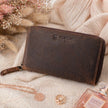








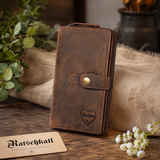
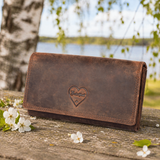
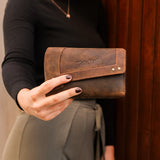
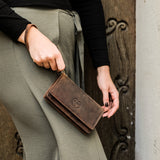
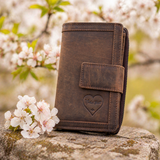
"Large" isn't a size, it's a promise: that everything will fit and you'll still find what you're looking for. Whether that promise holds depends far less on the outer dimensions than on how the inside is laid out. A large wallet with six card slots is a note case with a lot of empty space. A medium one with fourteen compartments can be the better choice.
This article is about one question only: which format, how many compartments, which closure. Everything about style, material and workmanship is in the detailed women's guide, and we won't repeat it here.
Small, medium, large: what the labels mean in practice
The three terms aren't standardised sizes, but across the trade they mean roughly the same thing.
- Small: fits in a jacket pocket and carries what you need day to day. Notes get folded.
- Medium: the compromise. Enough card slots for everyday life, still small enough for a shoulder bag.
- Large: notes lie flat, there are several rows of compartments and usually a separate coin section. In return, the wallet needs a bag it will actually go into.
The outer dimensions and the number of card slots for any given model are listed on its product page. The figures vary from wallet to wallet, and the category only tells you which league you're searching in: either specifically among the large wallets or across the whole range of women's wallets.
How many card slots you really need
Count them rather than guessing. For most people the stack looks like this: debit card, credit card, health insurance card, driving licence, ID card, two to four loyalty cards, plus a railcard and a library or work pass. That's eight to fourteen cards, considerably more than most people estimate.
The rule of thumb is: the number of cards you carry plus two spare slots. Anything beyond that is empty space you carry around every day.
Because plenty of slots costs you thickness. A card is just under a millimetre thick, and the leather around it adds as much again. Twelve filled slots come to a good two centimetres before a single note goes in. So the question isn't how many slots a wallet has, but how many of them you'll actually fill.
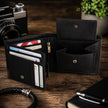
The arrangement makes a difference too. If the slots are staggered one above another, you see every card at a glance, but you need height. If they sit side by side in several rows, the wallet gets wider and you have to leaf through. If having an overview is your main reason for wanting a large format, look for the staggered version — that's what the large formats are built for.
Card slots are only half the calculation anyway. On top come the note compartment, the coin section and the slip pockets for receipts, stamps or a parking ticket. Two separate note compartments are the quiet luxury of a large wallet: one for cash, one for everything else that would otherwise get mixed in among the notes. If lots of compartments are genuinely meant to create order for you, look for that separation and not just at the number of card slots.
Two special cases to finish: a clear window for your ID is handy, but it costs you a slot. And cards you need twice a year don't belong in your wallet — they belong in a drawer.
When a zip is worth it
Large wallets come in three constructions. Choosing between them is a practical decision, not a matter of taste.
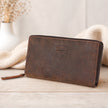
- Zip all the way round: nothing falls out, even if your bag tips over or the wallet ends up on its side in a rucksack. Good for lots of loose change, for cycling and public transport, and for anyone who throws the wallet into an open bag. Drawback: opening it takes two hands, and the zip is the component that wears out first.
- Press stud or flap closure: can be opened one-handed, quicker at the till. If the wallet is overfilled, though, it sits open.
- Zip on the coin section only: the middle way. The change is secure, the rest stays quick to get at.
So if you're looking for a large wallet with a zip, first work out whether you want the zip to run all the way round or just around the coin section. Those are two different products, even if the search terms sound the same.
What fits in which handbag
The most common disappointment isn't caused by the wallet but by the bag. Three cases:
- Small shoulder bag: a large wallet takes up half the bag and can only be pulled out on its end. Medium is almost always the better choice here.
- Shopper or large shoulder bag: this is where the large format shows its worth. The wallet doesn't disappear and you can grab it without looking.
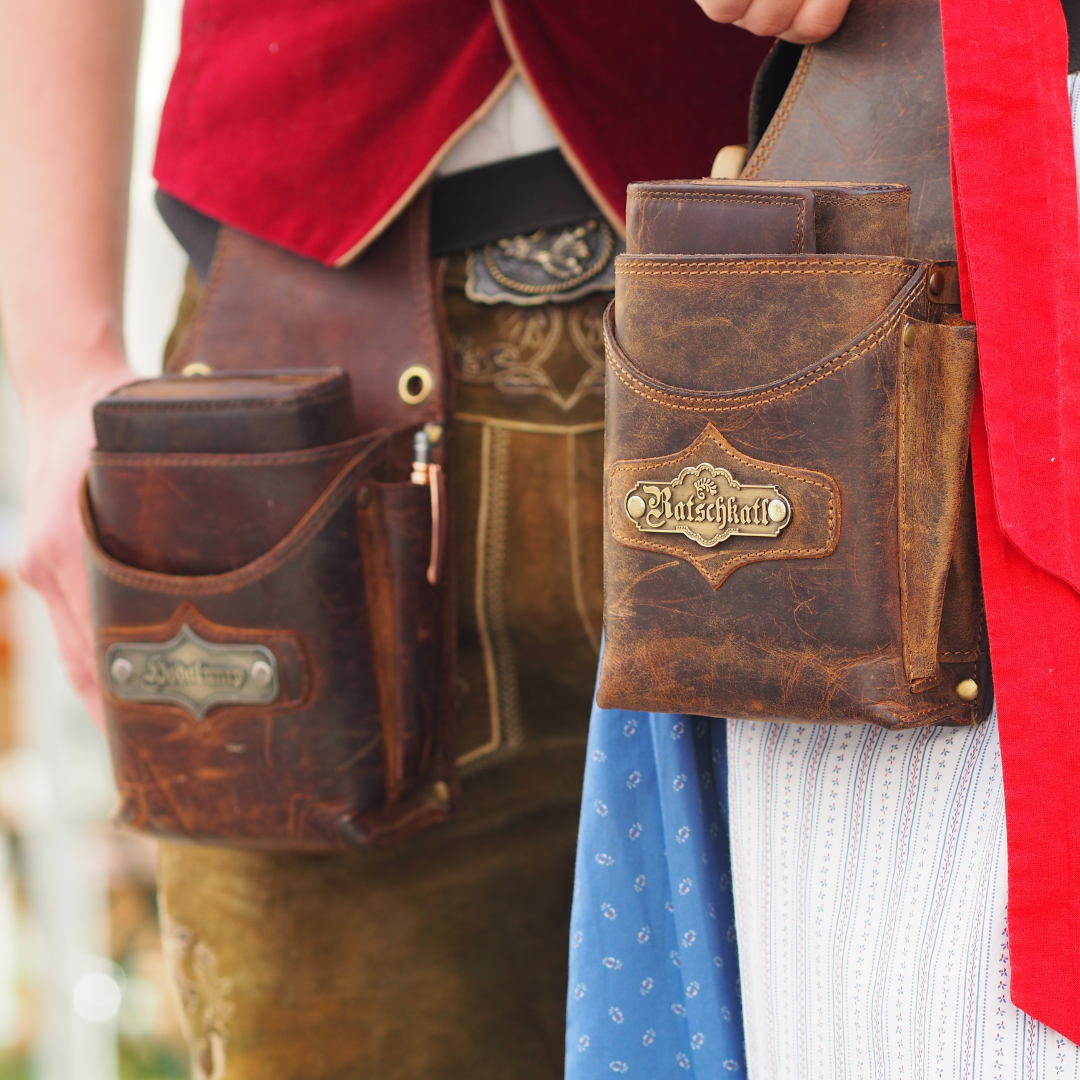
- Traditional Bavarian or evening bag: no room for a large format. There are small models for that, and dedicated bags for Oktoberfest in the Oktoberfest collection.
The simple test before you buy: measure the inside width of your everyday bag. If the wallet fits in lying flat, rather than having to be forced in on its end, the size is right.
And one more thing you only notice after buying: a large wallet gets heavy when it's full. That weight hangs off your shoulder every day. If you're going to carry the whole stack of cards, at least clear out the receipts once a week.
When a medium wallet is the better choice
Medium isn't a fallback. It's the right answer if you carry fewer than eight cards, if you rarely pay cash and so hardly carry any notes, if you sometimes take the wallet in your jacket without a bag, or if you switch between two bags and one of them is small.
Large is right if you have a lot of cards, pay in cash, collect receipts, and the wallet always lives in the same bag anyway.
Women's or men's: the difference is the format
Anyone after a large wallet with plenty of compartments ends up in the men's section surprisingly often. That's not a matter of taste, it's a confusion of formats. Men's wallets are built for a trouser pocket: compact, landscape, not much height. What counts there is set out in the men's guide and in the men's wallets collection.
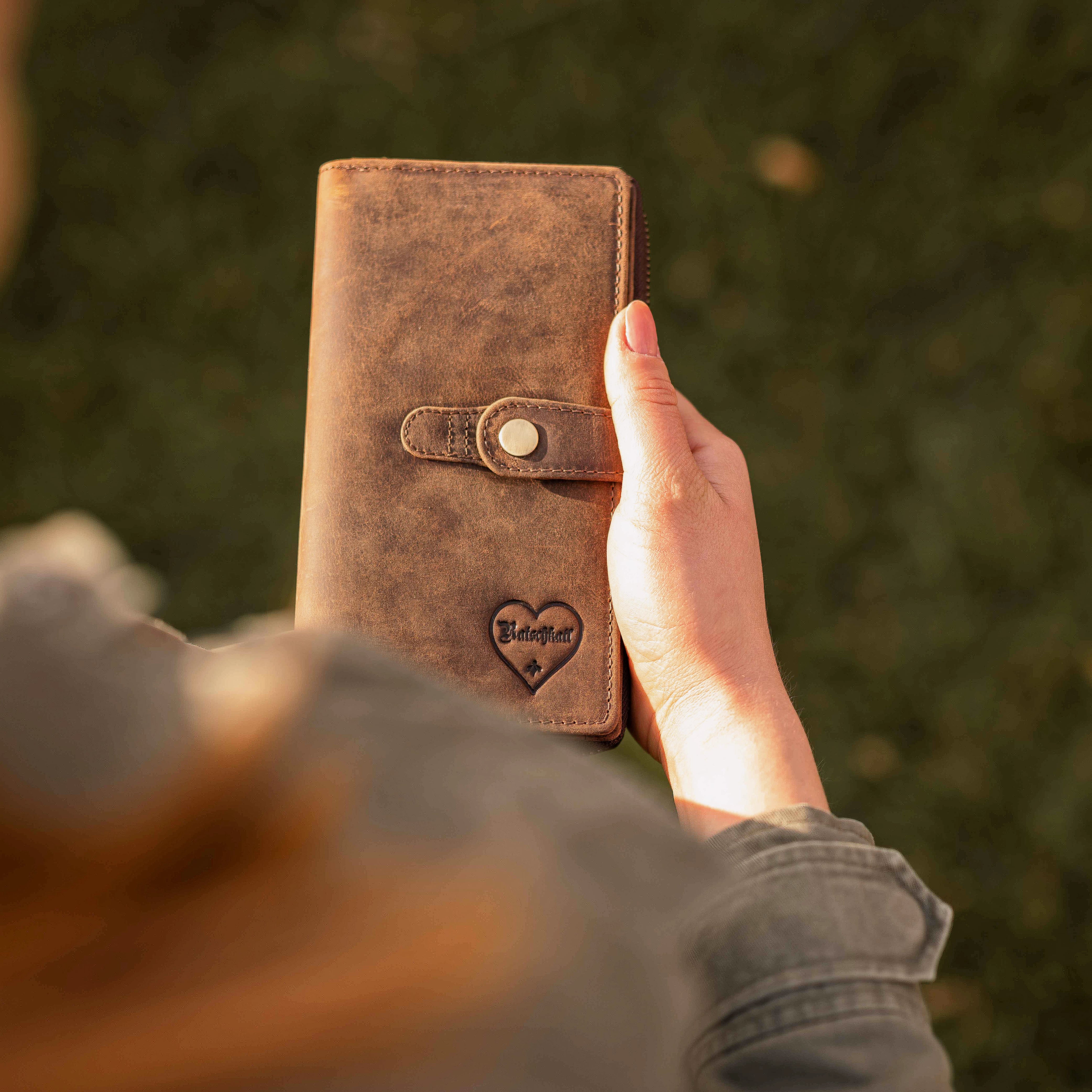
Large women's wallets are built for a handbag: more height, more rows of compartments, notes lying flat. If you want an overview of a lot of cards, the women's format is the right one — regardless of who's carrying it.
Which models to consider
The table above puts the models side by side with price and rating. For orientation: Soferl, Walli, Zenta and Theresa belong to the large formats, so they're the choice when overview and capacity are what tip the balance. Babsi represents the medium class and is in the table so you can see the difference directly.
The exact number of card slots, the measurements and the type of closure are given on each product page. Take the four questions from this article with you: how many cards do you really carry? Overview or compactness? Zip all the way round or just on the coin section? And does it fit flat into your bag?
Once those answers are clear, the shortlist gets short. A wallet that suits your bag and your number of cards will serve you for ten years. What counts after that is care.