











The backpack has had quite a career in the world of commuting. For twenty years it was seen as the thing you carried to school at sixteen. Today the head of department gets on the train with one, and the reason is entirely mundane: both hands are free, and the load sits on two shoulders instead of one.
That isn't a style argument, it's a physical one. This article works through the points that decide whether a backpack works for the city and the commute — straps, back panel, material, rain, and the question of how big it needs to be.
Why two straps make a difference on the commute
A shoulder bag hangs from one shoulder, and that shoulder pulls against it. Over ten minutes it makes no difference. Over two journeys a day, five days a week, it does — and you don't notice it in your back but in your neck, usually not until Friday.
The second point is your hands. Ticket, handrail, coffee, phone, child: anyone who commutes needs both hands regularly, and precisely in the moments when a bag is in the way. On a bike it stops being a question of comfort altogether and becomes the only sensible way to carry anything.
There is one situation in which a backpack is worse, and it's worth knowing about: the packed train. In a crowded aisle, a backpack on your back takes up the space of half a person, and you won't notice it yourself. Anyone standing in trains like that every day takes it off when boarding and puts it down between their feet. That isn't a rule of politeness, it's simply how it works.
Full leather, leather mix or recycled PET
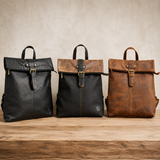
The five models in the leather backpacks are built differently, and that difference decides weight, weather resistance and price.
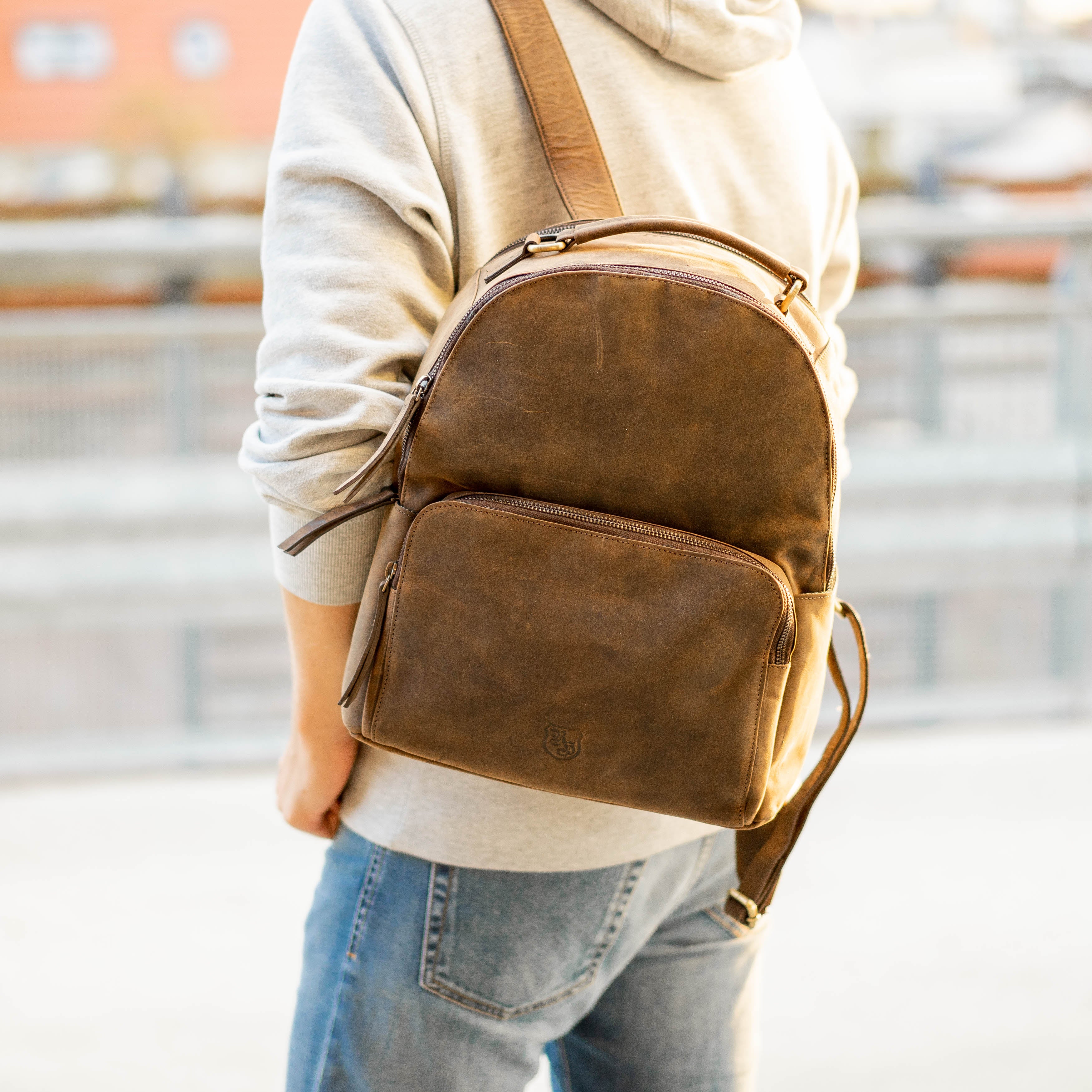
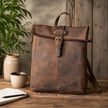
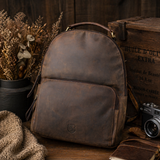
- Classic Rucksack Pako, €149.95: the classic model with a pared-back design. Roomy main compartment for a laptop, water bottle, notebook or shopping, small outer pocket for keys and headphones, padded shoulder straps, sturdy zip.
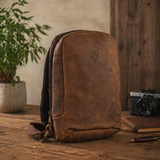
- City Bag Theodor, €99.95: the plainer city backpack. Main compartment, additional inner and outer pockets, padded shoulder strap. The strap adjusts from 74 to 105 cm and is 6.5 cm wide.
- Berg-Rucksack Robi, €89.95: the outdoor cut. Large main compartment for a jacket and packed lunch, inner and outer pockets, padded straps — and the only model on this list explicitly made from water-repellent material.
- Hodalump City Rucksack, €59.95: the lightest in the range. Ergonomically shaped shoulder straps and a reinforced buffalo leather base that protects the spot where a backpack gives out first.
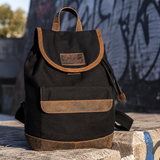
- PET Rucksack, €99.95: made from recycled PET. Main compartment with room for a laptop and water bottle, zipped pockets, adjustable shoulder straps, breathable back panel, water-repellent material.
What that means for choosing: if you want leather that develops a patina over the years, you'll end up with Pako or Theodor. If you cover long distances every day and count every gram, the lightweight City Rucksack. If you're out in all weathers, Robi or the PET model — the only two with documented water-repellent material.
On the PET material itself: it is recycled PET, and the product data says no more than that. You won't find percentages or certificates here, because there's nothing to back them up. What the material does in everyday use is covered in the article Bags made from recycled PET.
Straps and back panel — what you should really look at
With a backpack that gets carried every day, three things matter more than looks.
Strap width. Narrow straps cut in as soon as weight is added. The 6.5 cm on the City Bag Theodor is a workable figure — for daily use it shouldn't be any narrower.
Adjustability. A backpack sits correctly when its lower edge is roughly at hip height and the body of the bag isn't dangling at the backs of your knees. That needs room to adjust: on the Theodor it's 74 to 105 cm, which covers you with and without a winter coat. On the other models the straps are listed as adjustable, but without figures.
The back panel. Anyone who walks twenty minutes in summer knows why this counts. The only back panel explicitly described as breathable in the product data is that of the PET Rucksack. The leather models say nothing on the subject — which doesn't mean they're poor, only that leather is leather and sits accordingly against your back in high summer.
What appears in none of the descriptions: a chest or hip strap. If you regularly carry heavy loads and want a backpack that transfers the weight onto your hips, ask about that specifically — it isn't something that can be claimed here.
Rain: what water-repellent means and what it doesn't
Water-repellent is not waterproof. It means: a shower on the way to the station does no harm, drops bead off, and what's inside stays dry. It does not mean: twenty minutes on a bike in steady rain. For that, even a water-repellent backpack needs a cover, or the laptop goes into a case of its own.
With leather the situation is different. Leather copes with wet better than most people think, but it wants proper treatment afterwards: not on the radiator, not in the sun, dried slowly at room temperature and then sparingly fed with grease. How sparingly is set out in Applying leather grease correctly — the most common mistake is too much, not too little.
How big, when no litre figure is given
Here comes the honest part: none of the five backpacks has a capacity stated in litres. If you want to compare 22 against 28 litres, this product data won't let you.
What can be said instead is what fits inside according to the descriptions. On the Pako, the Theodor and the PET Rucksack the main compartment is explicitly designed for a laptop, water bottle and notebook — in other words, the typical commuter load. On the Robi it's described in terms of a jacket, packed lunch and water bottle, so more about bulk than flat items.
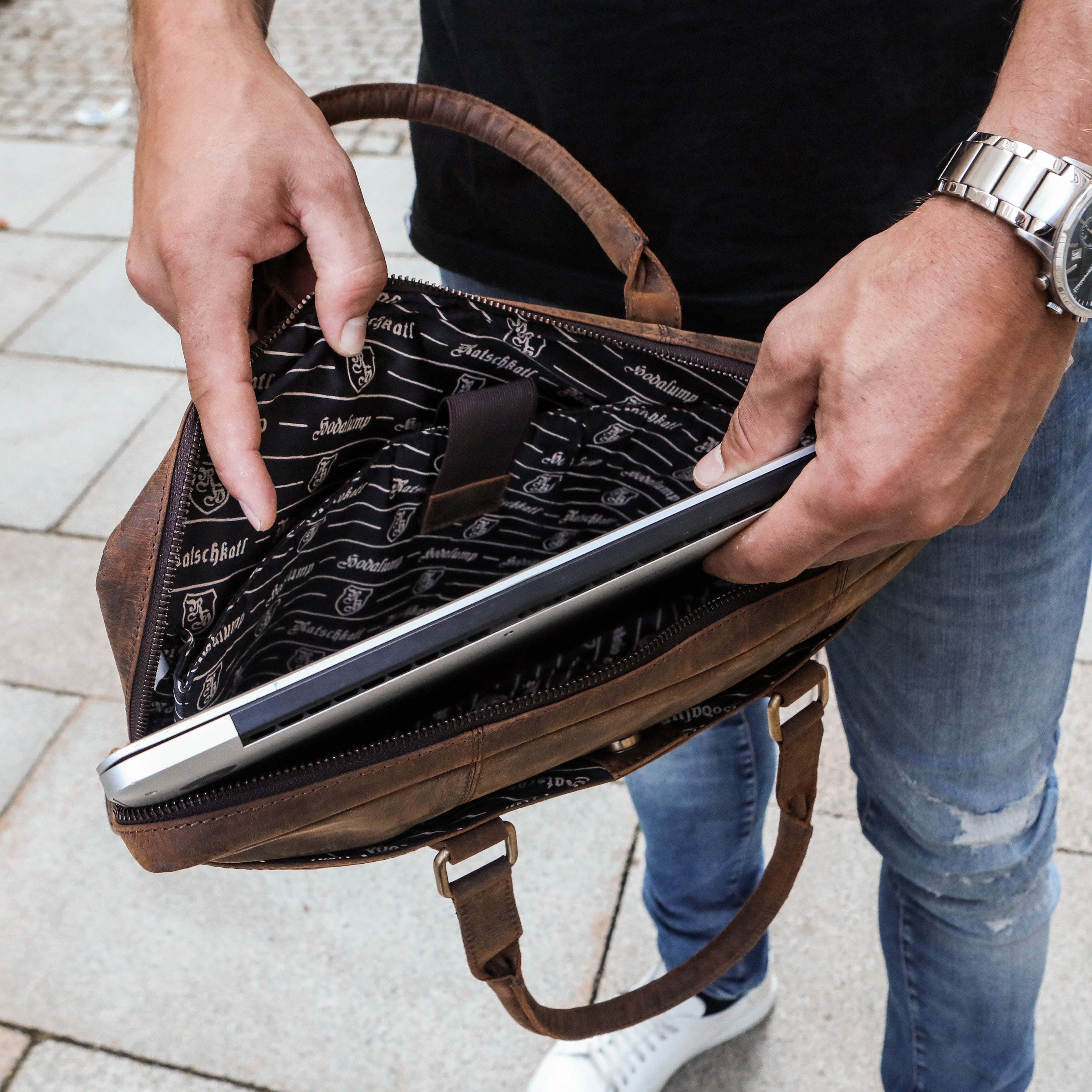
None of the backpacks gives a laptop size in inches. If your machine is bigger than 14 inches, that's an open question — and the way to settle it is the same as with bags: measure the device and, in case of doubt, plan for a protective sleeve. If you take a laptop with you every day and don't want to do without a documented padded compartment, a laptop bag will serve you better than a backpack.
And one more point that only becomes apparent after a few months: on a backpack, the zip is the part that gives up first. It gets moved two to four times a day, often one-handed and at an angle. On the Pako it's explicitly described as sturdy, on the Theodor as a protective closure. If you get the chance, that's exactly what to test in the shop: fully open once, fully closed once, with the main compartment full.
When a backpack doesn't fit the occasion
There are situations in which a backpack remains the wrong choice, however well it carries. At a client meeting where you turn up in a suit, a backpack parked next to the chair reads differently from a briefcase. That's illogical, but that's how it is, and arguing against it gets you nowhere.
The practical way to handle it: two pieces of luggage for two kinds of day. The backpack for the commute and for everything that happens internally. A bag for meetings. If you'd rather not do that, take the plainest model — the City Bag Theodor, with its minimalist cut, draws the least attention. Further shapes can be found in the men's bags and the leather bags.
What the decision finally comes down to
If you reduce the five models to three questions, this is what's left. Will it be carried every day and does it need to last? Then leather, so Pako at €149.95. Does every gram count and should it be affordable? Then the lightweight City Rucksack at €59.95. Are you often out in bad weather? Then the Robi or the PET model.
The table above puts the five side by side, with the recommendation up front. And if the backpack is going to be a gift: it's one of the few things where the size doesn't have to fit and yet the taste still has to be right — in case of doubt, the plain model is the safer choice over the eye-catching one.