

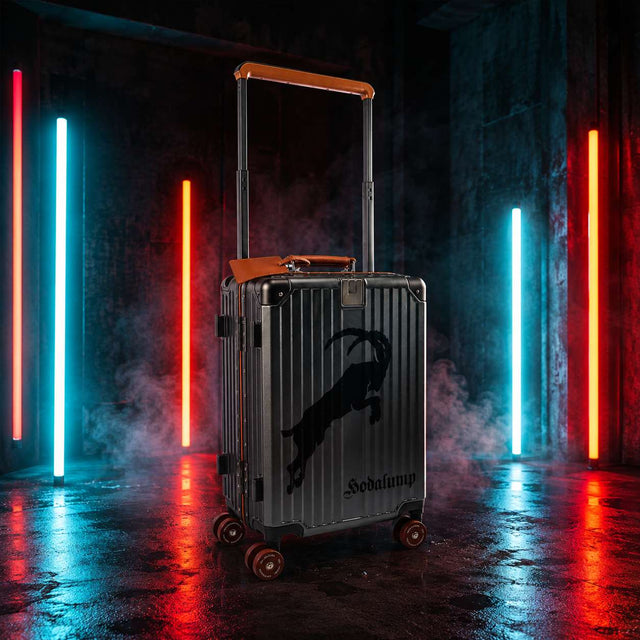


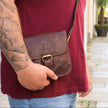

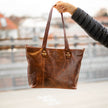












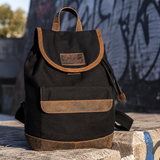
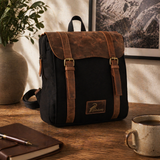
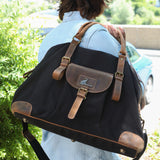
Four models in our range are made from recycled PET: a shoulder bag at €39.95, a rucksack, a large holdall and a travel bag sized for cabin luggage. Until now each of them stood on its own product page. Anyone wanting to know what this material is actually worth in everyday use found nothing on the subject. We're making up for that here.
The table above shows the line with prices at a glance. Below it you'll find what a PET fabric can do, what it can't, where leather remains the better choice — and what we deliberately do not claim about this material.
What recycled PET actually is
PET is the plastic drinks bottles are made of. Recycled means: used PET is collected, cleaned, shredded into flakes, melted down and drawn into fibres. The fibres become a yarn, the yarn becomes a fabric, and the fabric is sewn. That's how it works in textile manufacturing generally.
What comes out of it is a polyester fabric — technically the same material as in rain jackets, hiking rucksacks or tent groundsheets. It doesn't feel like leather, it doesn't age like leather, and it doesn't want to be treated like leather either. That's precisely what determines whether a bag like this suits you.
You won't find the recycled percentage for the individual models here. Why not is explained further down — that's not an oversight, it's deliberate.
Weight, water, care: what you notice day to day
Weight
The clearest difference. An empty fabric rucksack weighs noticeably less than a cowhide one of comparable size. On the way to the office you'll barely notice, but after eight hours around town, or at the third gate of the day, you will. Anyone who has held an empty leather bag knows that a good share of the weight you carry is the bag itself, not what's in it.
Water
Polyester fibres don't soak through the way cotton does. Drizzle tends to bead off rather than sink in, and whatever does get wet dries quickly. What we're not saying: that these bags are waterproof. Whether a downpour stays outside depends on the coating, the seams and the zips — and we have no tested figures on that. Reckon on a shower on the way to the train, not four hours of steady rain.
Care
This is where it gets pleasant. Fabric needs no leather grease, no reproofing by the calendar, no feeding before winter. A damp cloth, a little mild soap if needed, then leave it out to dry — that's it. Not in the washing machine, because zips, fittings and seams suffer needlessly in there. For comparison: what a leather bag really needs is set out in our guide to leather care. The effort involved is of a different order, and in this decision that's a genuine argument.
Wear
Leather and fabric fail in different ways. With leather it's usually the surface that's the issue: scratches, dry patches, abrasion along the edges. With a fabric bag the surface is rarely the problem — there, it's the moving parts that give way first. The zip, the buckle, the stitching where the strap joins. So if you want to keep a PET bag for a long time, don't watch the fabric, watch the zip. And repair it instead of throwing the bag away.
PET or leather — what each one is for
We sell both, and we have no interest in recommending the wrong one to you.
- PET fabric: light, unbothered by rain, easy to care for, cheaper to get into. Suits commuting, sport, travel, festivals — anywhere the bag has to work rather than look good.
- Leather: heavier, dearer, wants looking after. In return it develops a patina, can be fed and repaired, and looks better after five years than it did on day one.
One sentence that sums both up honestly: fabric doesn't get more beautiful over the years, it just gets older. If that leaves you cold, because for you the bag is a tool, then PET is the more sensible choice. If it doesn't leave you cold, take a look at the leather bags instead.
The four models and what they're good for
Recycled PET shoulder bag, €39.95
The entry point to the line and the cheapest model. A shoulder bag made from recycled material for the things you carry on you anyway: phone, wallet, keys, charging cable. Across the shoulder, hands free. For the market, a gig, a city break and the journey to work. If you want to try for the first time whether fabric will do instead of leather, this is the bag where you risk the least.
PET rucksack, €99.95
The line's everyday rucksack. Both shoulders instead of one, so you walk upright even fully loaded — over months of daily commuting, that makes a difference. For the journey to the office, to lectures, into town.
PET holdall, €129.95
The larger bag format for anyone who doesn't want a rucksack — to carry by hand or over the shoulder. As a sustainable sports bag, as a weekender, as the bag for a weekend at your parents'. We're not stating how many litres it holds, because we have no tested capacity figure. Roughly measure what you usually take with you beforehand and compare it against the dimensions given for the model.
PET cabin travel bag, €129.95
The line's travel bag, intended by name for cabin luggage. One tip that will save you grief: cabin baggage dimensions differ from airline to airline and change regularly. Don't rely on the word "cabin" — check the measurements against your airline's rules before you book. For train, car and coach it makes no difference: there, all that counts is that a sustainable travel bag is light and doesn't take offence when it ends up in the boot wedged between two crates.
The reviews for all four models are in the table above.
Is it sustainable? What we can say, and what we can't
This is the point where most articles start inventing numbers. We'll pass.
We say: these models are made from recycled PET. We don't say what percentage, because we have no reliable figure for it. We name no label and no certificate as long as we don't hold one. We won't work out for you how many bottles a bag is equivalent to — conversions like that sound good and can almost never be verified. And we claim no CO₂ figure, because a serious carbon balance takes more than the name of a material.
What we do consider reliable: the most sustainable bag is the one you use for ten years. That holds for fabric as much as for leather. Buy the model that fits how you travel, rather than two that half fit — and repair the zip instead of replacing the bag. As soon as we have verified figures on recycled content and certification, they'll be here. Not before.