
























The same thing usually goes wrong when buying a laptop bag: people compare inch figures. „Fits up to 15 inches" against „14-inch laptop" — it sounds unambiguous, but it isn't. Inches measure the screen diagonal, not the housing. Two 14-inch machines can differ by two centimetres in width, because one has a slim bezel and the other doesn't.
The rest of this article sorts out the three questions a laptop bag actually turns on: size, padding, how you carry it. And at the end comes the case in which a bag is the wrong answer altogether.
Inch sizes: what 15, 16 and 17 inches mean
The inch figure quoted for a bag is an upper limit for common devices in that class — nothing more. It says nothing about whether your particular model, with its particular housing, will fit inside, and certainly nothing about whether it will fit with a protective sleeve as well.
Hence the practical route: take a tape measure and measure your device for width, depth and height. A laptop at 32 × 22 × 1.8 cm is a different proposition from one at 38 × 26 × 2.4 cm, even though both are called „15 inch". Those three numbers are the only figures you can genuinely compare with.
What the product data says for the individual models varies in precision:
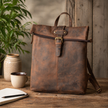
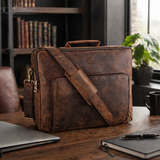
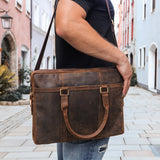
- Ben laptop bag, €129.95: for all common laptop sizes up to 17 inches, MacBooks included. Brown vintage buffalo leather, untreated, oiled and buffed, with reinforced seams.
- Daniel large laptop bag, €179.95: up to 16 inches, plus accessories and documents. Handcrafted from strong, untreated buffalo leather.
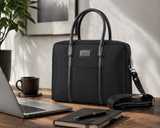
- Gecko business bag, €99.95: up to 15 inches. Hard-wearing textile material with leather details.
- BLACK business bag, €99.95: up to 15 inches, same construction in black.
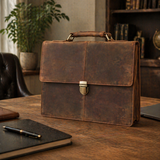
- Tom briefcase, €99.95: genuine leather, room for a laptop, documents and a notebook — no inch figure is given for this model.
That makes the order of things clear: if you have a 17-inch machine, you have exactly one choice in the range. If you are on 13 or 14 inches, you have all of them. And if you are somewhere between 15 and 16 inches, measure rather than guess.
Padding: which bags have a dedicated compartment for the device
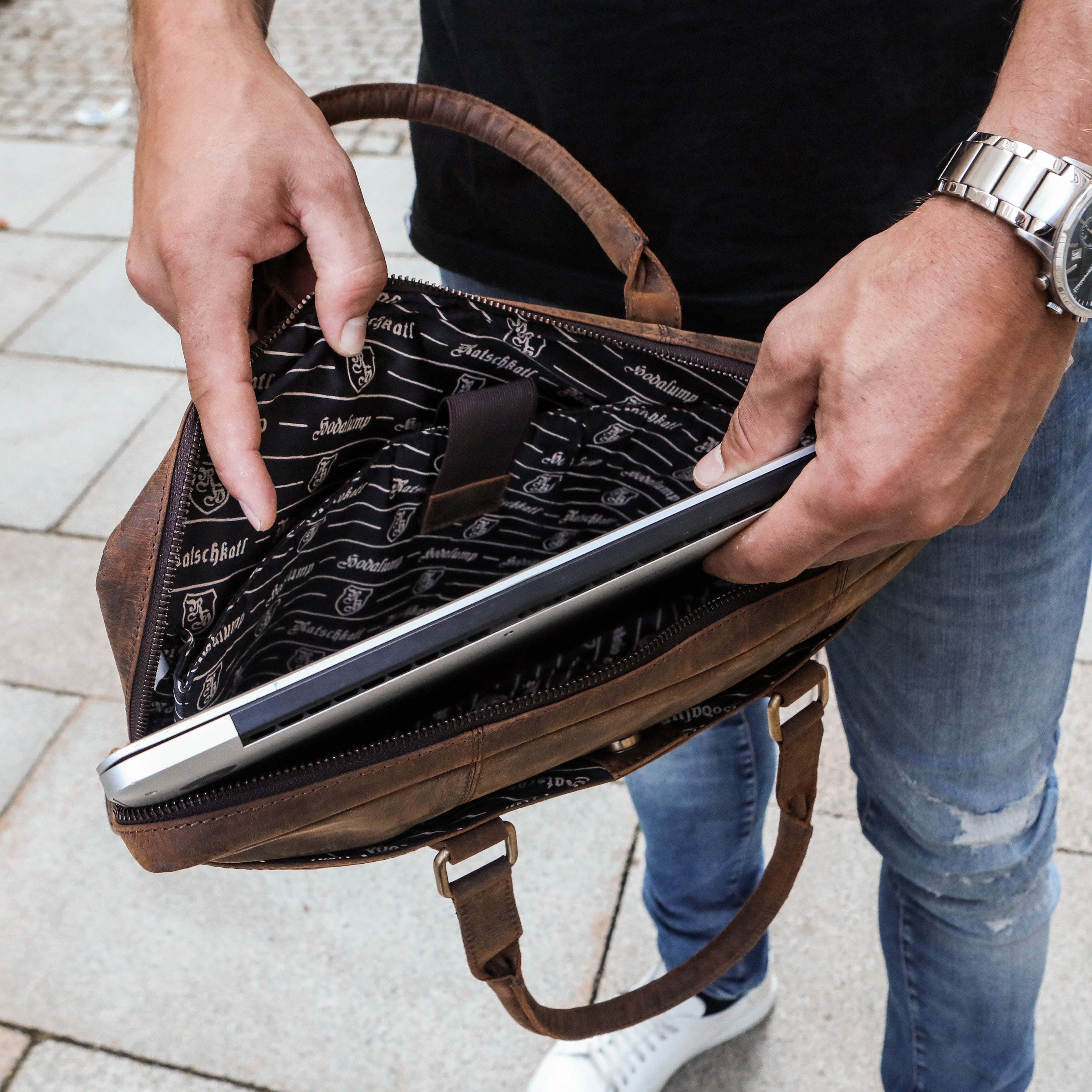
A laptop rarely dies from a fall and often from everyday life: an edge against a table leg, the bag against a door frame, the rucksack toppling over as you set it down. What helps against that is not a soft lining but a dedicated padded compartment in which the device does not sit directly against the outer wall.
With the Daniel large laptop bag that is exactly what is documented: a padded laptop compartment inside, plus separate compartments for charger, notebook and mouse. The Jordan briefcase at €169.95 also has a padded laptop compartment, as do the textile models Gecko and BLACK, for which padded compartments and slip pockets are specified.
For the Ben laptop bag the product data says nothing about padding. It is described as a leather bag with reinforced seams and a well thought-out interior layout — which is not the same thing as documented padding. If you are on the road a lot and want to be certain, put a neoprene or felt sleeve in between in this case. It costs little and settles the question.
A second point that often gets overlooked: the base. A bag you set down puts the device on its bottom edge. Models with a stiff leather base and a compartment that does not reach all the way down have a clear advantage here — and you only see it once the bag is in your hands.
Handles or shoulder strap — and when both
How you carry it shapes daily life more than the material does. Three cases:
Short distances, car, car park to office. Handles are enough. They are quicker to grab, the bag stands neatly beside the desk, and you put nothing on your neck.
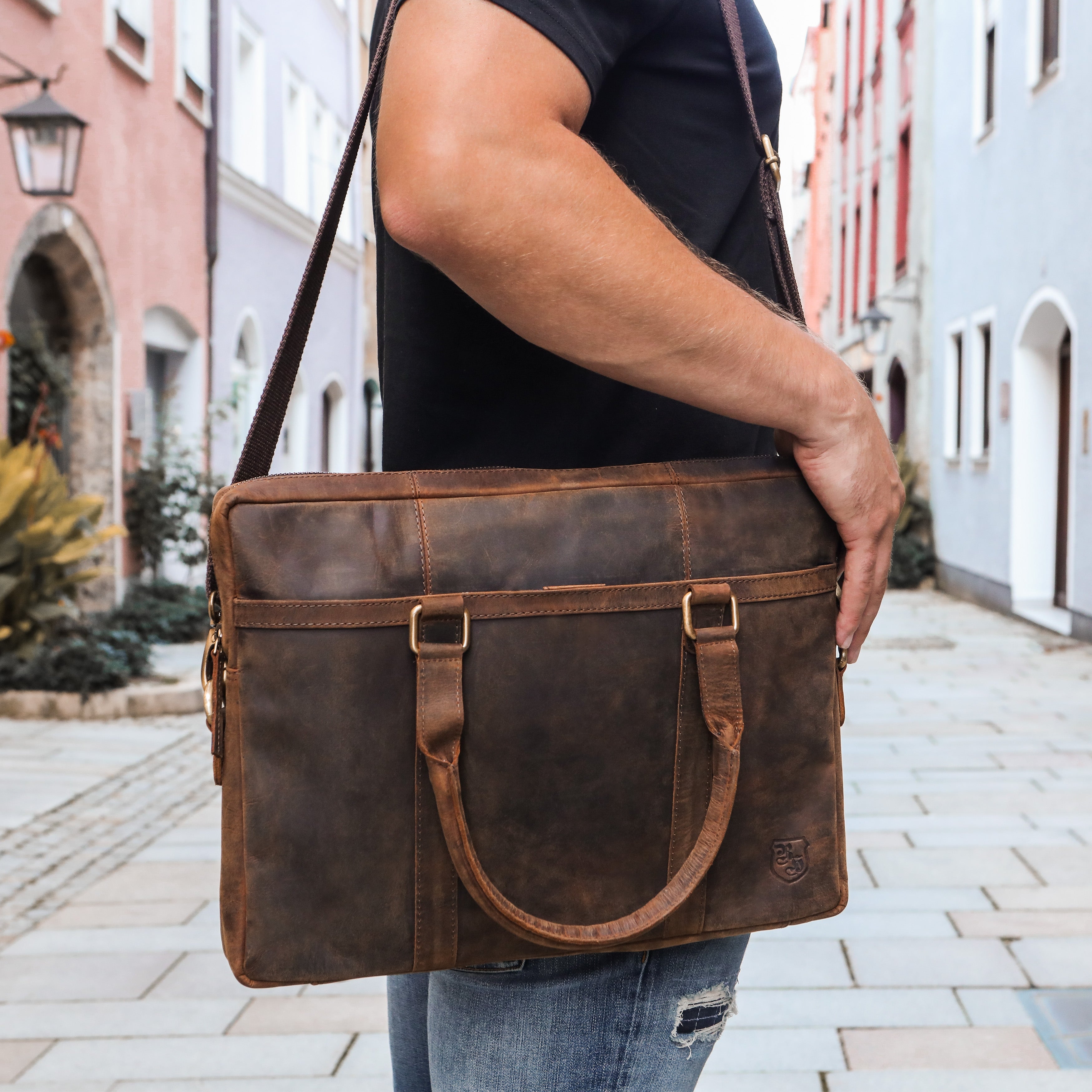
Train, bus, longer walks. A strap. A full leather bag with a laptop and power supply weighs enough that you swap hands after ten minutes. What matters is that the strap is adjustable — on the Daniel laptop bag it is, in addition to the sturdy carry handles. The same goes for the Gecko and BLACK.
Appointments with clients. Both, and alternating. That is why the shoulder strap on the Jordan briefcase is detachable: on the way it hangs over the shoulder, in the meeting it stands on its leather handles. A strap you can't take off is in the way in situations like that.
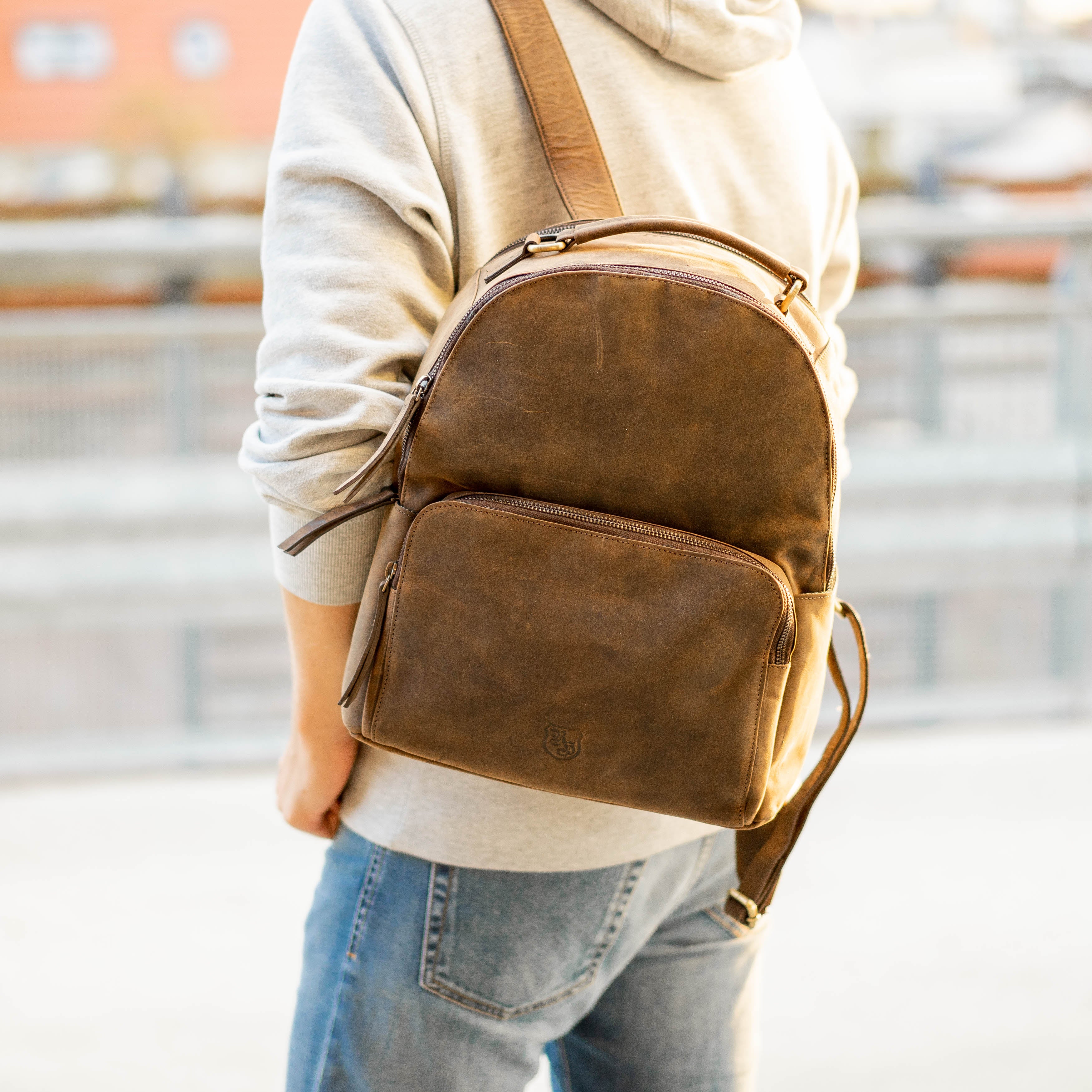
And the fourth case, which has to be named honestly: if you walk twenty minutes or more every day, cycle, or change trains with a full load, the right question is not „handles or strap" but „bag or rucksack". Two straps spread the load across both shoulders; a bag does not. What the range offers there is under leather rucksacks.
Leather or fabric — what the difference means day to day
The range includes both constructions, partly in the same price bracket, and they differ on three points.
Weight. Buffalo leather is heavy, noticeably so. The product data gives no weights, so no figure appears here — but the direction is unambiguous: if you hang the bag over your shoulder every day and are already at the limit of what you want to carry, at least consider the textile model.
Ageing. Leather darkens, picks up a sheen at the edges and looks better after three years than after three months. Fabric stays as it is until it wears through — and then you see it immediately at the rub points. If you want a bag that acquires a history, take leather. If you want one that stays practical, take fabric.
Weather. None of the models says anything about being waterproof. With leather that means, in practice: rain is no drama, sustained rain is, and wet leather does not belong on a radiator. How to treat it afterwards is set out in Applying leather grease properly.
What has to come along besides the laptop
A laptop on its own doesn't need a bag, it needs a sleeve. You need a bag because of the rest: power supply, mouse, notebook, papers, a charging cable for the phone, sometimes lunch.
That is why the layout of the compartments matters more than the volume. For the Daniel laptop bag, separate compartments for charger, notebook and mouse are specified, with additional zipped and slip pockets on the outside for quick access. The Jordan briefcase has, alongside the main compartment, several slip and zipped pockets, two large front pockets and a back pocket.
Why that counts: everything that sits in one big main compartment ends up underneath the laptop. A power supply under a device is exactly the kind of pressure point you don't see and notice later.
What separates the prices
The range in laptop bags runs from €99.95 to €179.95, and it follows a logic you can follow: at €99.95 you get either a textile bag with leather details or a plain leather bag. At €129.95, full leather in a larger format. At €169.95 to €179.95, buffalo leather with a fully developed compartment system and greater capacity.
If you want a version with a coat of arms on the front rather than the plain one, the Bayern emblem laptop bag at €129.95 gives you a model with an additional padded compartment for devices up to 15 inches. The rest of the range is under men's bags. The table above orders the five models by capacity, with the recommendation for carrying a lot of kit at the top.
When a laptop bag is the wrong choice
Three cases in which the money is better spent elsewhere.
First: if the laptop stays in the office and you only move between desk and meeting room — then a sleeve is enough. Second: if you commute and need your hands, see above, that is a rucksack. Third: if your work takes you around with tools or equipment and the laptop is just along for the ride — then a cabin and gym bag at €99.95, with plenty of room, a zipped compartment and two outer pockets, is closer to what you are actually transporting.
A laptop bag is a good buy when it travels between two places several times a week, has to look tidy while doing so, and carries more than the device. In every other case, an honest look at the alternative pays off.