
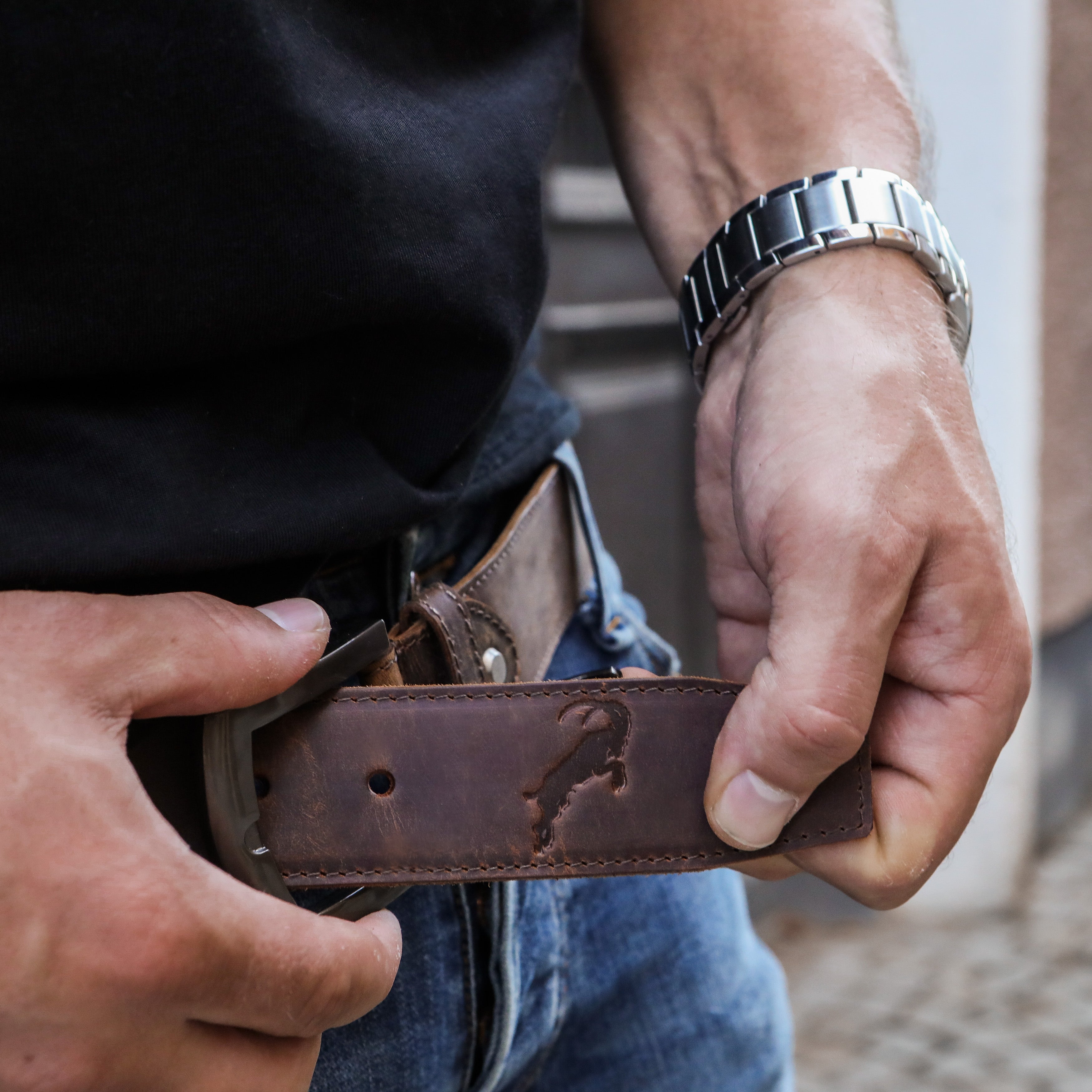








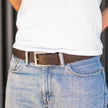



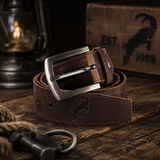
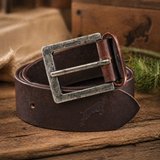
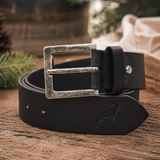
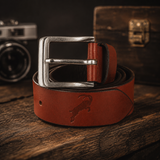
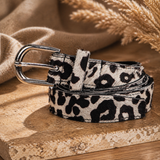
A belt with a hidden compartment sounds like more than it is. No safe, no armoured vault, just a narrow pocket on the inside of the leather that nobody can see from the outside. For what most people want it for, that's exactly enough: a few notes that aren't in the first place anyone looks.
This article clears up two things. First, what a compartment like this actually does day to day and what fits inside it. Second, how to recognise a leather belt you'll still be wearing in five years. The second part is the more important one. A hidden compartment isn't much use if the leather around it has worn through after two summers.
What the hidden compartment is, and what it can't do
The compartment sits on the inside, against your body, running along inside the leather. From the outside there's nothing to see on the belt with a hidden compartment, as long as all that's in there is paper.
One drawback comes with it, and we'll say it straight away: you can only get at the contents by undoing the belt. In a hotel room that's no problem. In the queue at the beer stand it's not a discreet manoeuvre. The compartment is meant for money you don't need — until suddenly you do.
And it's no protection against someone who knows belts like this exist. It's protection against the quick hand in your trouser pocket, against the lost rucksack, against the wallet left behind in a festival tent.
Travel, festivals, Oktoberfest: when it pays off
When you travel, the principle is separation. Carry everything in one place and, if it goes wrong, you lose everything at once. One note in your belt covers a taxi, a train ticket or a night's accommodation. Enough to get you out of an awkward situation without anyone having to block a card first.
At festivals there's rarely a locker and never a tent you can lock. The belt stays on your body, including overnight.
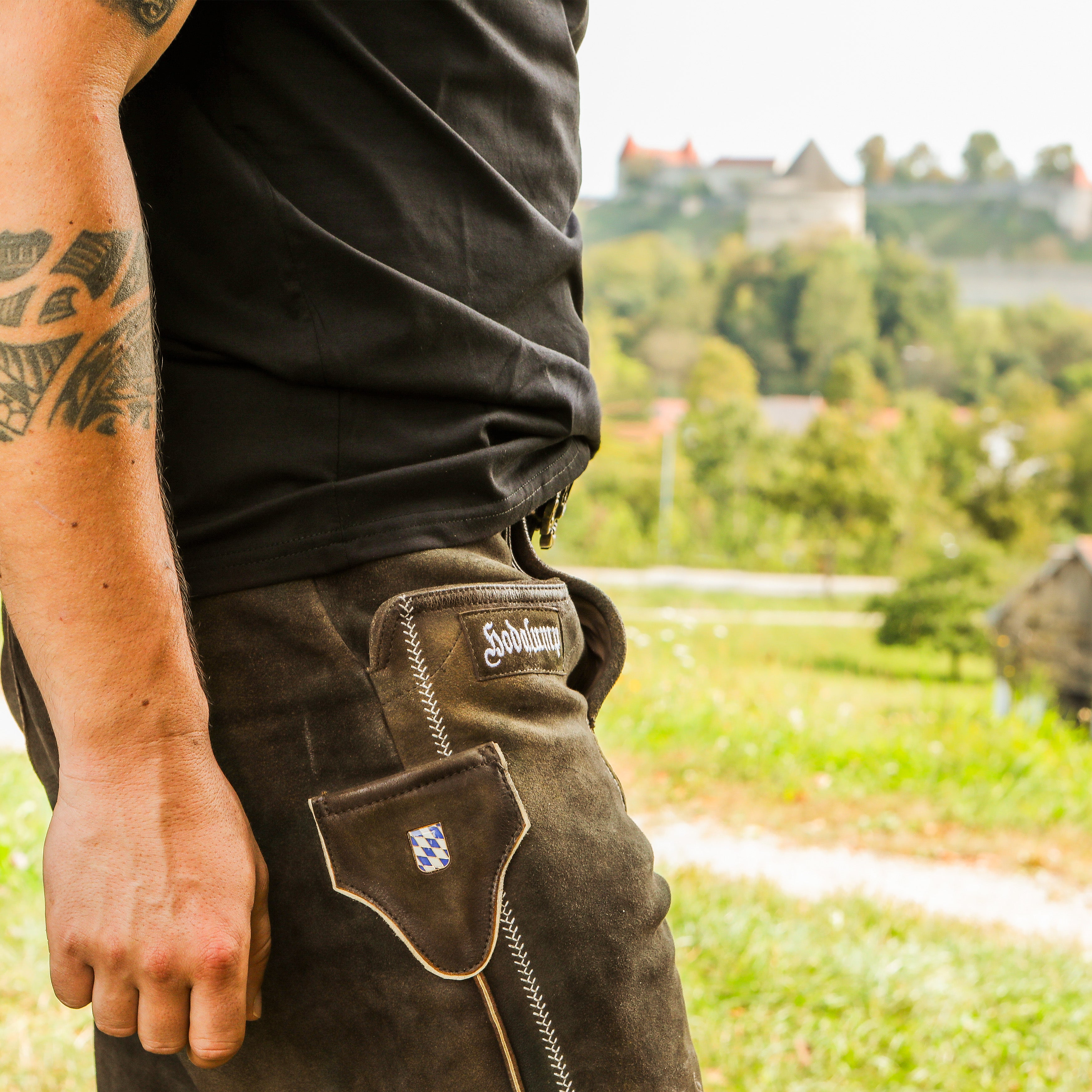
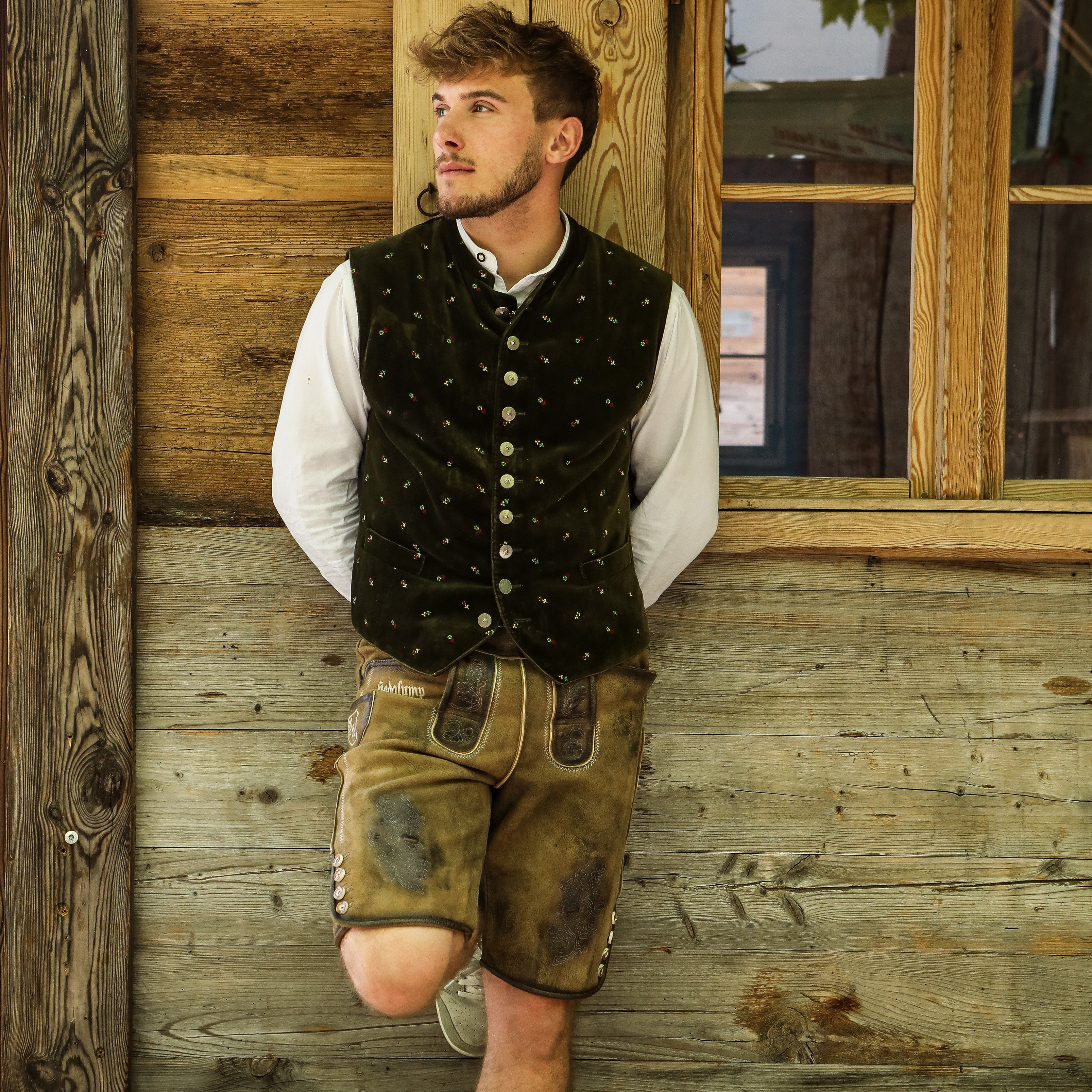
At the Wiesn — Munich's Oktoberfest — it's the crush that's the issue. Lederhosen have few pockets, and the ones they do have are shallow. The money for the journey home, which you won't need until the end of the evening, is better off in your belt than in a back pocket. Everything else that goes with traditional Bavarian dress is in the Oktoberfest collection.
What fits and what doesn't
Honestly: not much. The compartment is as tall as the belt is wide, and the belt measures 4 cm.
- Banknotes, folded: yes. Depending on the denomination, a note is 12 to 15 cm long and 6 to 8 cm high. Folded once lengthways and once across, it fits. Two or three notes and you won't notice them while wearing it.
- Cards: no. A bank or credit card measures 8.6 by 5.4 cm and can't be folded. It won't go into a 4 cm strip of leather however you turn it. If you want to hide cards on your body, you need a different product.
- Coins: no. They jingle, they shift around, and they dig in when you sit down.
- Slips of paper: yes. A phone number, an address, a backup code.
- Anything hard or with corners: no. Whatever doesn't give will show through the leather and press into you the moment you sit down.
That's the whole truth about the capacity. Expect more and you'll be disappointed. If it's exactly what you're after, it costs €29.95, and the 141 reviews averaging 4.80 suggest the expectation is usually about right.
How to recognise a good leather belt
Now the part that applies to every belt, compartment or not. Three places decide whether it lasts: the leather, the edge, the buckle.
The leather
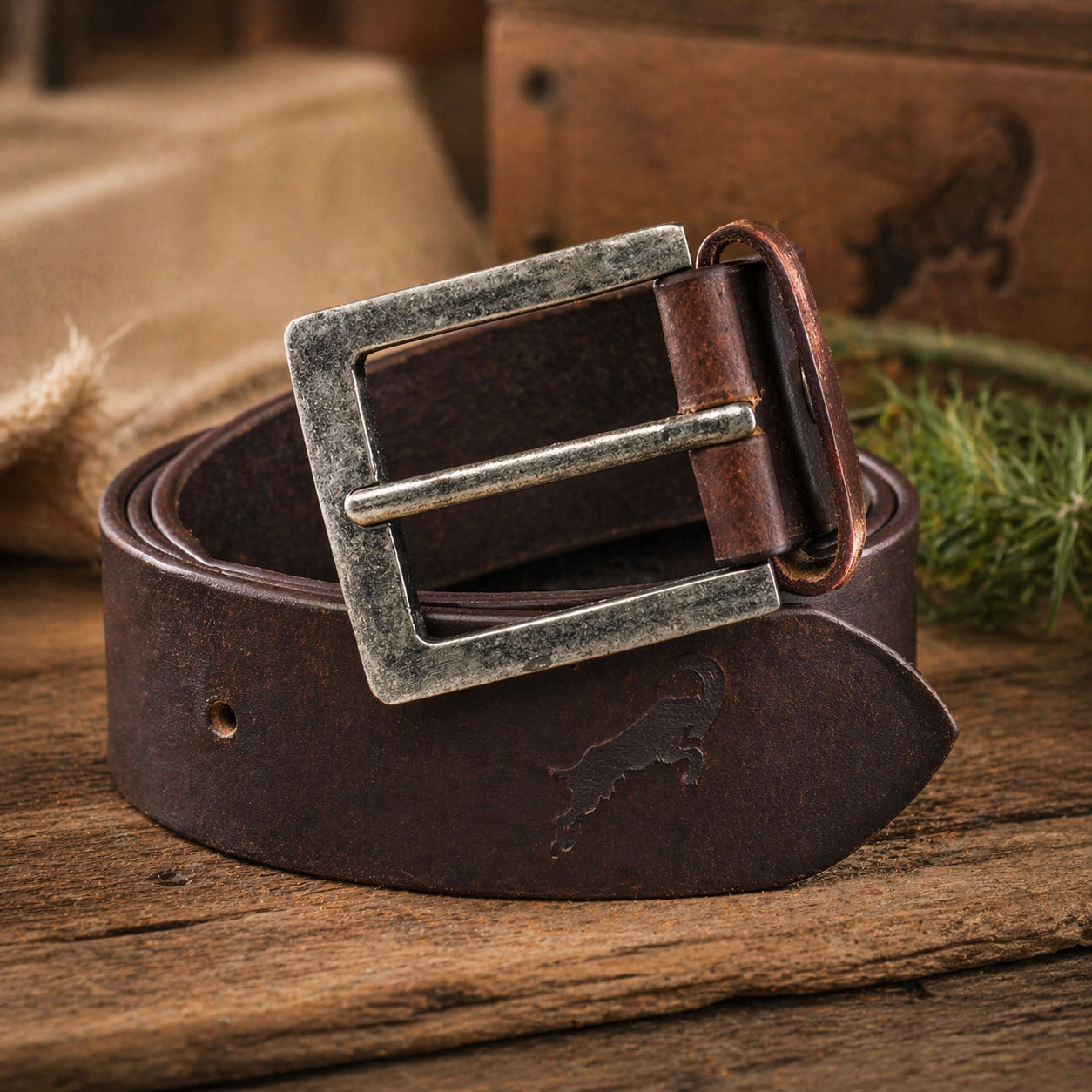
A belt gets bent, pulled and dragged across your hips thousands of times. Which is why its construction counts for more than its looks. A single continuous piece of cowhide or buffalo leather lasts. A belt made of thin layers glued on top of each other will eventually come apart at the edge. You can spot it on the cut edge: a layered construction shows a seam line there.
Buffalo leather has the coarser, more irregular grain and is very strong under tension. Cowhide comes out more uniform. Oiled means suppler, darker, and quicker to take on a patina. The belt with a hidden compartment is made of oiled buffalo leather, and that comes with a note we're not going to hide. It can rub off onto light-coloured fabric. If you're wearing the white linen trousers, pick a different model.
The edge
The edge is where the workmanship shows. Run a fingernail along it. If it's smooth, bevelled and dyed, someone has worked on it. If it's rough and fibrous, it will fray within a few months, because that's where the belt rubs most inside the loops.
The second place to look is the stitching at the buckle end. Almost every belt gives way where the leather is folded around the buckle. Dense stitching, backstitched several times, is worth more here than any decorative tooling.
The buckle
The pin buckle is the classic, and its advantage is that there's almost nothing on it that can break. Look out for two things. First, whether the buckle is solid metal or merely plated: plated castings show bare edges at the corners after a year. Second, whether it can be taken off. Removable means repairable, and it means you can shorten the belt yourself.
Measuring your belt size, the most common mistake
The mistake is always the same: people order their trouser size. But a belt size isn't a clothing size, it's a length measurement — and every manufacturer measures differently.
Our rule is: belt size = from the seam at the buckle to the third hole. So size M means 85 cm to the third hole with a total length of 100 cm, L is 95 cm, XL 105 cm, XXL 115 cm. The Ratschkatl models among the leather belts start smaller, at 70 cm, and go up to 100 cm.
Here's how to measure: lay your favourite belt out flat and unfastened. Measure from the seam at the buckle to the hole you actually use. That figure is your belt size. If you fall between two sizes, take the larger one. You can shorten a belt; you can't lengthen it.
Which belt for whom
The table above puts the models side by side with price and rating. Sorted briefly:
- The belt with a hidden compartment is the travel and festival belt: 4 cm wide, oiled buffalo leather, compartment on the inside, belt sizes from 85 to 115 cm.
- Belt in brown and belt in black are the everyday belts with no extras, cowhide, metal buckle, shortenable.
- The two-tone belt is reversible, black on one side, brown on the other. Handy when travelling, because it replaces two belts.
- The Ratschkatl belts in leopard and crocodile textures cover the smaller sizes from 70 cm up.
Only the one model currently has a hidden compartment, and its smallest size is 85 cm. If you need smaller than that, there's no belt with a compartment in the range. Worth saying, because we're often asked.
Care: ten minutes a year
A belt needs very little. Two or three times a year, apply a thin coat of leather grease, above all at the fold points and around the holes, because that's where the leather dries out first. Let leather that has got wet dry slowly, never on a radiator. The details are in our guide to applying leather grease and in the care guide. That one is written for wallets, but it applies to belts just the same.
Looked after like that, a leather belt outlasts most of the trousers it holds up. The hidden compartment is then the extra you genuinely need once or twice a year — and at that precise moment wouldn't want to be without.