








A belt is the item of clothing you put on every morning and never look at. It holds your trousers up, it sits where it should, done. You only notice it when the leather tears at the buckle, or when it dawns on you that you have been fastening it on the last hole for two years.
So no prose about quality here, just the four questions that actually decide things: which leather, which width, which length, which fit. And where the answer is not documented, that is stated too.
Which leather is any good for a belt
A belt is stressed differently from a wallet. It gets pulled, bent and creased in the same place every time — where the prong goes through the hole. What counts is not how the surface looks, but whether the leather gives way along the row of holes.
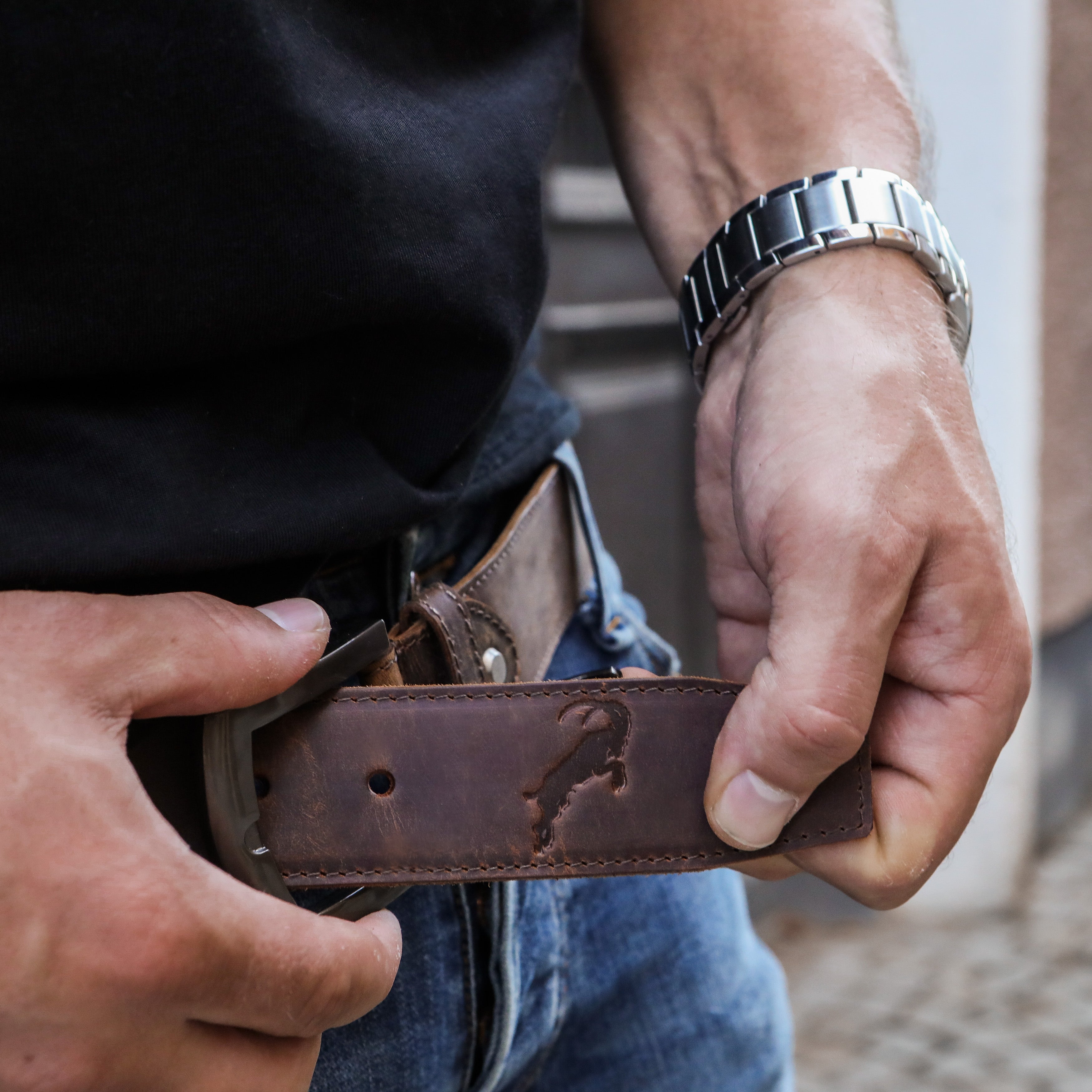
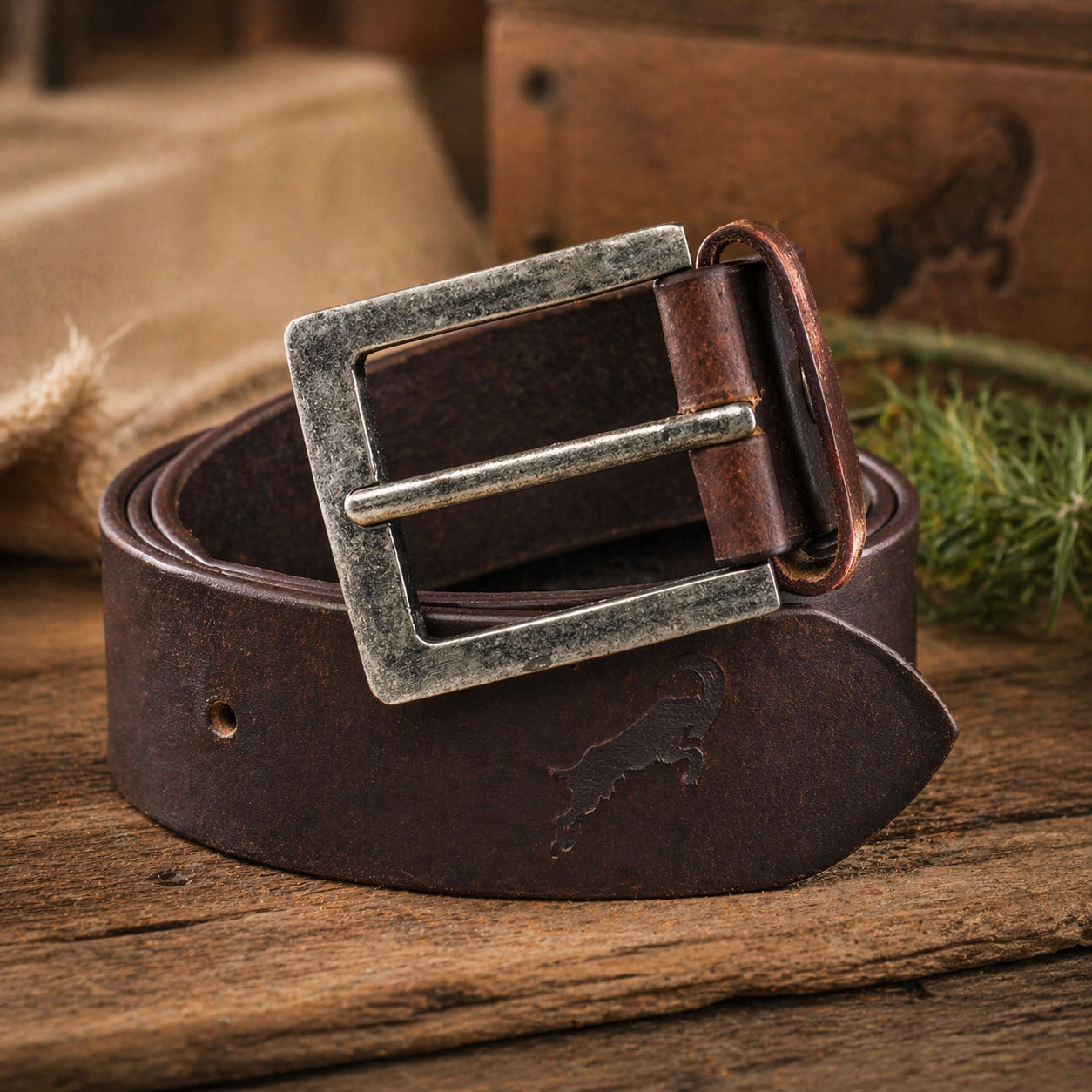
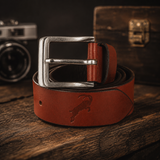
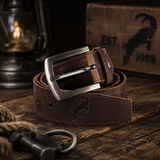
There are two base materials in the range. The Brown Belt at €29.95 is made from cowhide and has a classic metal buckle. The Belt with Hidden Pocket, also €29.95, is made from oiled buffalo leather — the more rugged option, noticeably thicker to the touch, which develops a more pronounced patina over time.
The practical difference is more mundane than you might think: oiled buffalo leather can rub off onto light-coloured fabric. That is stated in the product description, and it is the single most important sentence about leather types in this whole article. If you wear light chinos or linen trousers, you are better off with the cowhide belt or the Black Belt.
What is not stated here, because it is not documented: the tanning method and the leather thickness in millimetres. Both are readily sold as marks of quality in buying guides, and neither can be given reliably for these belts. If somebody explains which tannage your belt has without a spec sheet in front of them, they are guessing.
Why four centimetres is the standard width
All four men's belts in the leather belt range are 4 cm wide. That is not an arbitrary figure but the width that fits through the belt loops of almost every pair of jeans and work trousers.
Where it gets tight: slim-cut suit trousers. Their loops are sometimes only made for 3 to 3.5 cm. If you want to wear the belt with a suit, hold a ruler against the loop on your trousers before you order — it takes ten seconds and saves you a return. A 4 cm belt forced through a loop that is too narrow looks buckled at the hip.
Length: why your trouser size is no help
The most common mistake when buying a belt is to take the trouser size straight across. Trousers with a 95 waist do not need a 95 cm belt, because the belt runs around the outside of the trousers, not inside them.
Hodalump measures the waist size like this: from the seam at the buckle, excluding the buckle, to the third belt hole. The third hole is the middle one — from there you have room in both directions. The total length is the measurement to the very end of the belt.
| Size | Waist (to 3rd hole) | Total length |
|---|---|---|
| M | 85 cm | 100 cm |
| L | 95 cm | 110 cm |
| XL | 105 cm | 120 cm |
| XXL | 115 cm | 130 cm |
So if you are looking for a 95, you end up with L. If you fall between two sizes, take the smaller one — all four belts can be shortened at home, but none of them can be lengthened.
The most reliable method if you are unsure: take the belt you wear today and measure from the seam at the buckle to the hole you actually use. Compare that figure with the waist column. Do not measure the waistband of your trousers, and do not measure around your stomach.
How a belt should sit
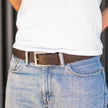
It sits correctly when you fasten it on the middle hole and your trousers stay up without the fabric bunching. The Brown Belt has five ready-punched holes — two inwards, two outwards, counting from the third.
Two signs the size is wrong: you permanently need the first or the last hole. In that case the belt is a size too big or too small, and both cost you durability — on the outermost hole the entire load pulls at the edge, on the innermost the surplus end sticks out.
The free end may reach past the first loop, but not as far as your trouser pocket. If it is too long, shorten the belt at the buckle end. The row of holes will then line up with your fit again.
The buckle — the part that annoys you first
All the men's belts here have a metal prong buckle. That is the design that can be repaired if the prong bends out of shape, and it works without any mechanism.
A note for anyone with allergies: with the Kroko Ratschkatl Belt it is expressly stated that the buckle is not nickel-free. For the other belts there is no information on nickel content — if you react sensitively, that is a question to clear up before buying rather than one to have answered here.
Which of the four belts for what
Everyday wear, jeans, visible patina: the Brown Belt, €29.95. Cowhide, metal buckle, the classic of the range. It shares a pooled rating of 4.66 from 480 reviews with the Black Belt — so that figure applies to both together, not to either one on its own.
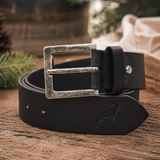
Business, dark trousers, understated: the Black Belt, €29.95. Matt surface, solid metal buckle, keeps a low profile.
If you only want one: the Belt in 2 Colours, €29.95. Reversible between black and brown — one buckle, two sides. For people who would otherwise have two belts in the wardrobe, one of which is always in the wrong room.
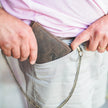
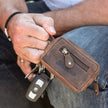
Travel and festivals: the Belt with Hidden Pocket, €29.95. A flat pocket for banknotes is concealed on the inside, invisible from the outside. How that works day to day and what fits inside is covered in detail in the article Belt with hidden pocket. Do bear the rub-off warning above in mind.
The weightlifting belt is not an everyday belt
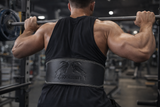
The Weightlifting Belt at €59.95 shows up in search results for leather belts, but it has nothing to do with them. It is made of genuine leather, has 22 holes, a double-prong metal buckle and a wide back section that stabilises your lower back during squats and deadlifts.
It does not fit through trouser loops, and you would not want to wear it off the gym floor anyway. It sits in the clothing collection, not with the belts, and rightly so.
For women: the Ratschkatl belts start at 70 cm
The men's belts start at an 85 cm waist. If you are smaller than that, the right lengths are in the Ratschkatl models: the Kroko Ratschkatl Belt at €24.95 runs from 70 cm (S) through 85 cm (M) and 100 cm (L) up to a 110 cm (XL) waist, the Leo Ratschkatl Belt at €29.95 in ten-centimetre steps from 70 to 100 cm.
Both are made of cowhide with an embossed texture, both have a prong buckle and both can likewise be shortened at home. The width of these models is not properly recorded in the product data — here the only thing that helps is a look at the product photo.
Belts with traditional Bavarian dress
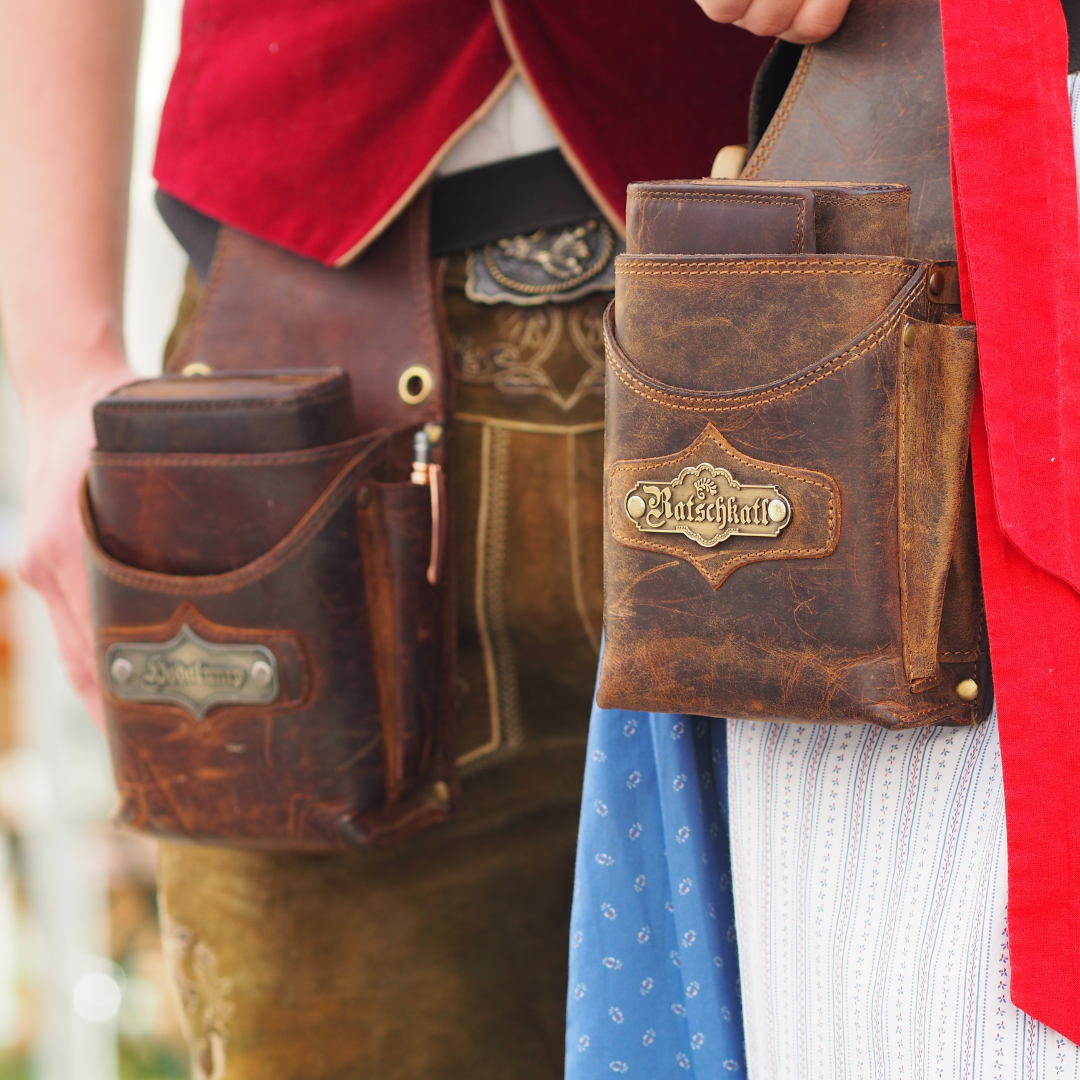
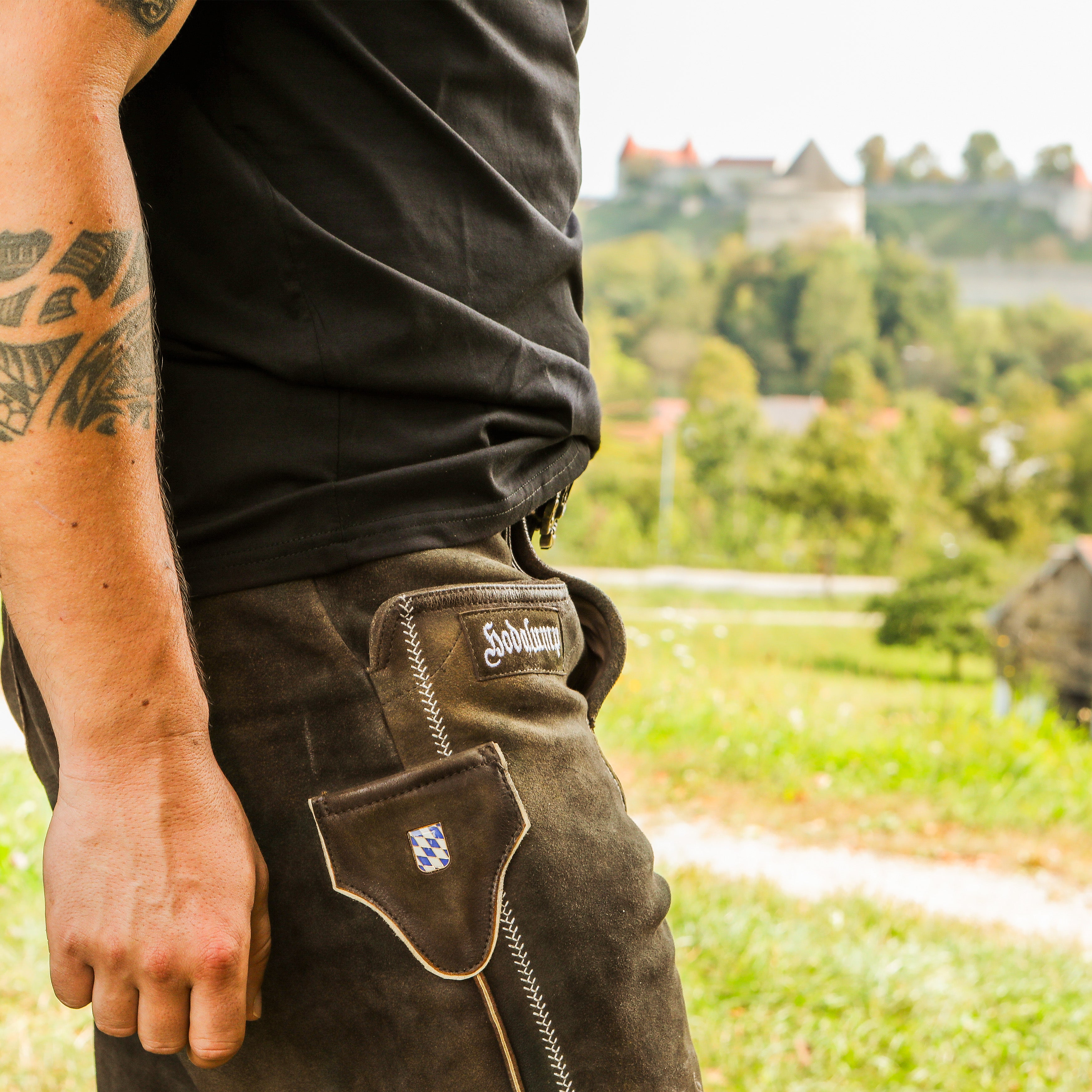
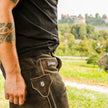
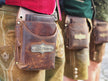
With lederhosen — the traditional Bavarian leather trousers — things work differently: the belt sits lower, and the trousers often have ideas of their own. What goes together is shown in the Oktoberfest collection; the black and the brown belt both work with traditional dress — the real question is whether you want to match the buckle to your shoes.
Care: once a year is enough
A belt needs less attention than a wallet, because it is not folded open and shut all the time. Wiping it down dry is normally enough. Once or twice a year, work a little leather care product into the flesh side and along the row of holes, which is where it tears first.
Do not soak it and do not put it in the washing machine. If the belt has got wet, let it dry in the air — not on a radiator. For the treatment itself there is leather grease at €8.95; how much of it you need and how to apply it without leaving the leather blotchy is covered in the article Applying leather grease.
In short
Width: 4 cm, unless the loop on your suit trousers says otherwise. Length: do not go by trouser size, measure the belt you already own. Fit: third hole. Leather: cowhide if you wear light-coloured trousers, oiled buffalo leather if patina matters more to you than a clean waistband. Everything else is taste — and taste is settled faster by looking at the product photo than by reading a text.