




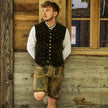



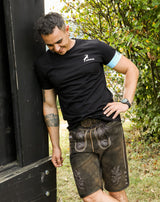


Yes, a T-shirt works with lederhosen. The only question is which one — and at what point you are better off in a shirt.
That is the short answer. The long one follows below: which T-shirt sits right, when the occasion calls for a shirt, which shoes work, and the four things that will sink an otherwise good look. If you want to know what matters when buying the lederhosen themselves, the article Buying lederhosen is the better place. This one is only about what goes above and below them.
Yes, a T-shirt works — but not just any T-shirt
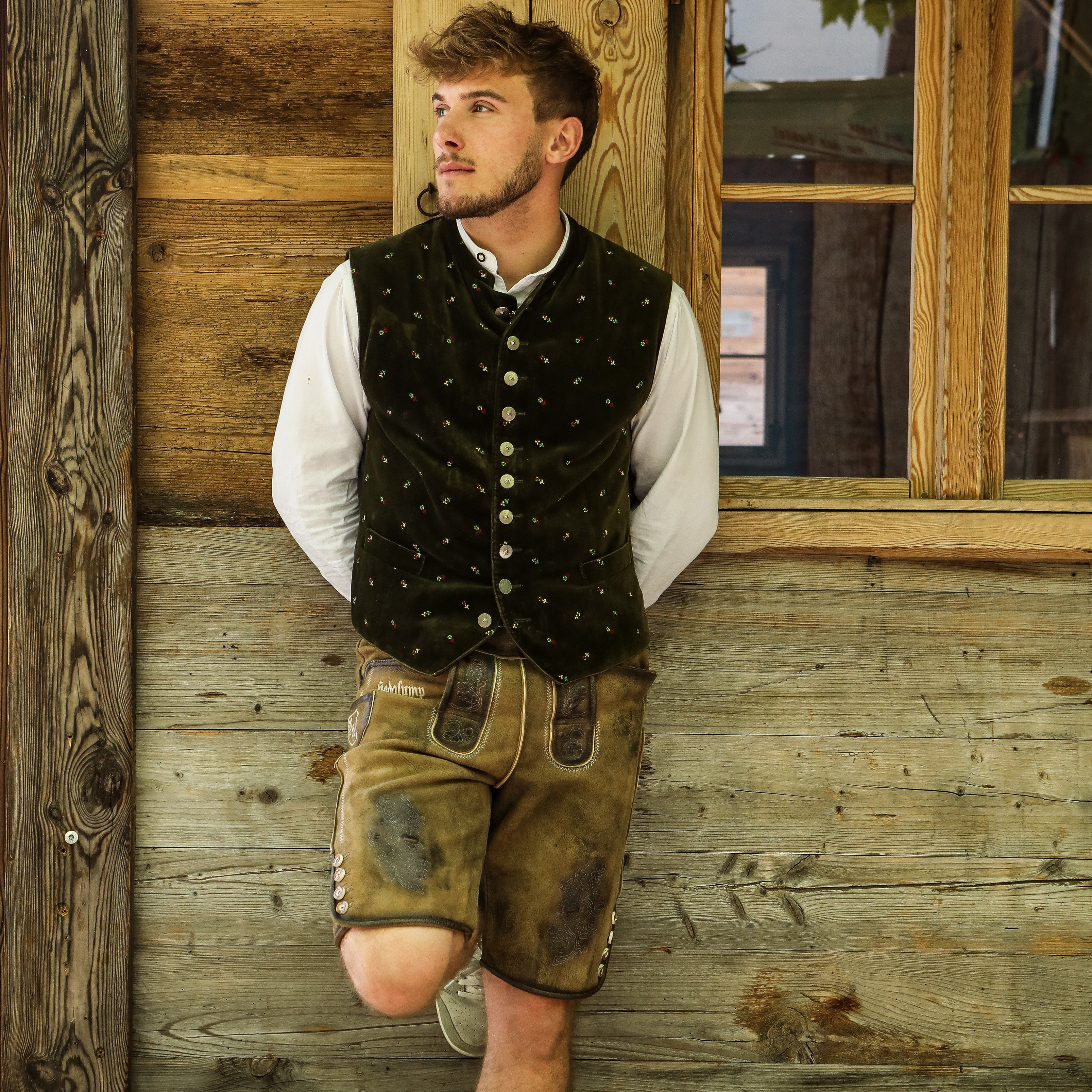
Lederhosen are a loud garment. They have colour, texture, usually embroidery, and stitching you can see from three metres away. Whatever goes on top does not have to compete, it has to stay quiet. That is the whole reason plain T-shirts almost always work and patterned ones almost never do.
Three things decide whether a T-shirt sits right with lederhosen:
- The length. The shirt should end just above the waistband or a few centimetres below it. It does not get tucked in. A shirt that hangs down over the front flap takes away exactly what you bought the lederhosen for.
- The shoulder seam. It belongs on the shoulder bone, not halfway down your upper arm. That is the difference between a T-shirt and a pyjama top, and it shows in every photo.
- The fabric. A beer tent can easily hit 28 degrees in the afternoon. Cotton copes with that. A polyester shirt is clinging to you after two hours.
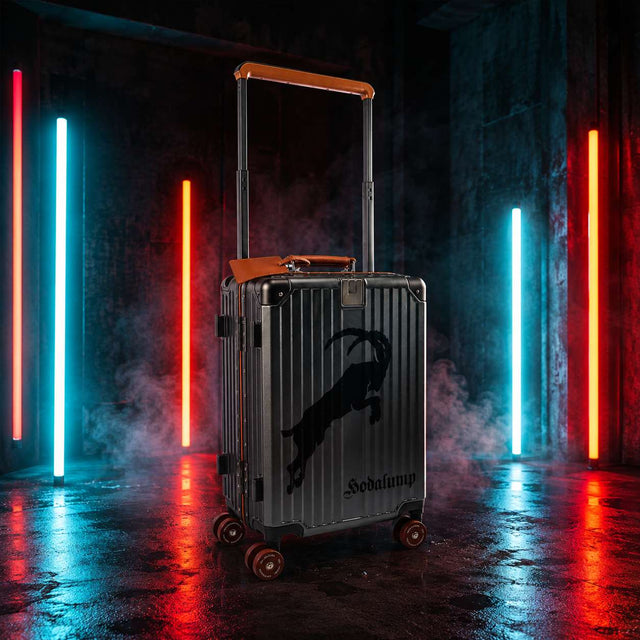
The Hodalump Bavaria T-Shirt at €34.95 is black, made of 95% cotton and 5% elastane, and comes in M to XXL. It carries a large back print with two ibex — a statement, not an exercise in restraint. If you are already wearing a hat and a belt with your lederhosen, that is one thing too many. If the shirt stays the only eye-catcher, it works well.
The quiet option is a plain shirt with no motif. White, black, dark green, navy. That is never wrong with lederhosen, and it is the answer whenever you are unsure. For women the shop stocks the women's T-shirt at €29.95 in S to L, slightly fitted with a round neck.
When to reach for a shirt after all
The decision is not a matter of taste but of occasion. And the dividing line is surprisingly sharp.
Shirt: weddings, christenings, company parties, a Trachtenball (a formal ball in traditional Bavarian dress), anything from dinner time onwards, and anything with a photographer walking around.
T-shirt: a beer festival in the afternoon, a beer tent, Kirchweih (the village church fair), a barbecue, a town festival, a walk up to an alpine hut.
There is also a practical argument that has nothing to do with style: a shirt has two settings. Buttoned up in the afternoon, sleeves rolled and the top button open as soon as it gets crowded and warm. A T-shirt has one setting. At an event that runs from three in the afternoon until midnight, that is a genuine difference.
And because we would rather write it down than let you search: we do not stock traditional Bavarian shirts. The clothing range covers T-shirts, waistcoats, jackets and gloves, but no shirts. If you pick one up elsewhere — white or blue-and-white check, that is all the rules you need.
Which shoes go with lederhosen
Of all the parts of the outfit, the shoe is the only one where you can genuinely get it wrong. Nobody notices a mediocre T-shirt. The wrong shoes, they notice.
Haferlschuhe
The obvious answer, and the one that cannot go wrong. The Bayern Haferlschuhe at €79.95 — the traditional Bavarian shoe with lacing at the side — are made of cowhide and have a profile sole that grips on a damp beer tent floor. They come in sizes 41 to 46, with a sole length of 28 cm in size 41 up to 32 cm in size 46.
The advantage is not only visual. A Haferl is a closed, firm leather shoe with a proper tread. After twelve hours standing in a tent you will notice the difference to a flat trainer.
Plain trainers
These work as long as they are one colour: white, black, dark brown, with no logo fireworks, no neon sole, no chunky cushioning wedge. It is the combination you now see on the majority of people at any beer festival, and it looks good as long as the shoe is clean. A grey, worn-out gym shoe drags the whole outfit down.
What doesn't work
- Flip-flops and pool slides.
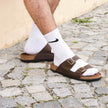
- Sandals with socks. It is not a cliché, you see it every year.
- Running shoes in three colours with visible cushioning.
- Formal shoes with a smooth leather sole. They slip on a wet tent floor, and wet it will be.
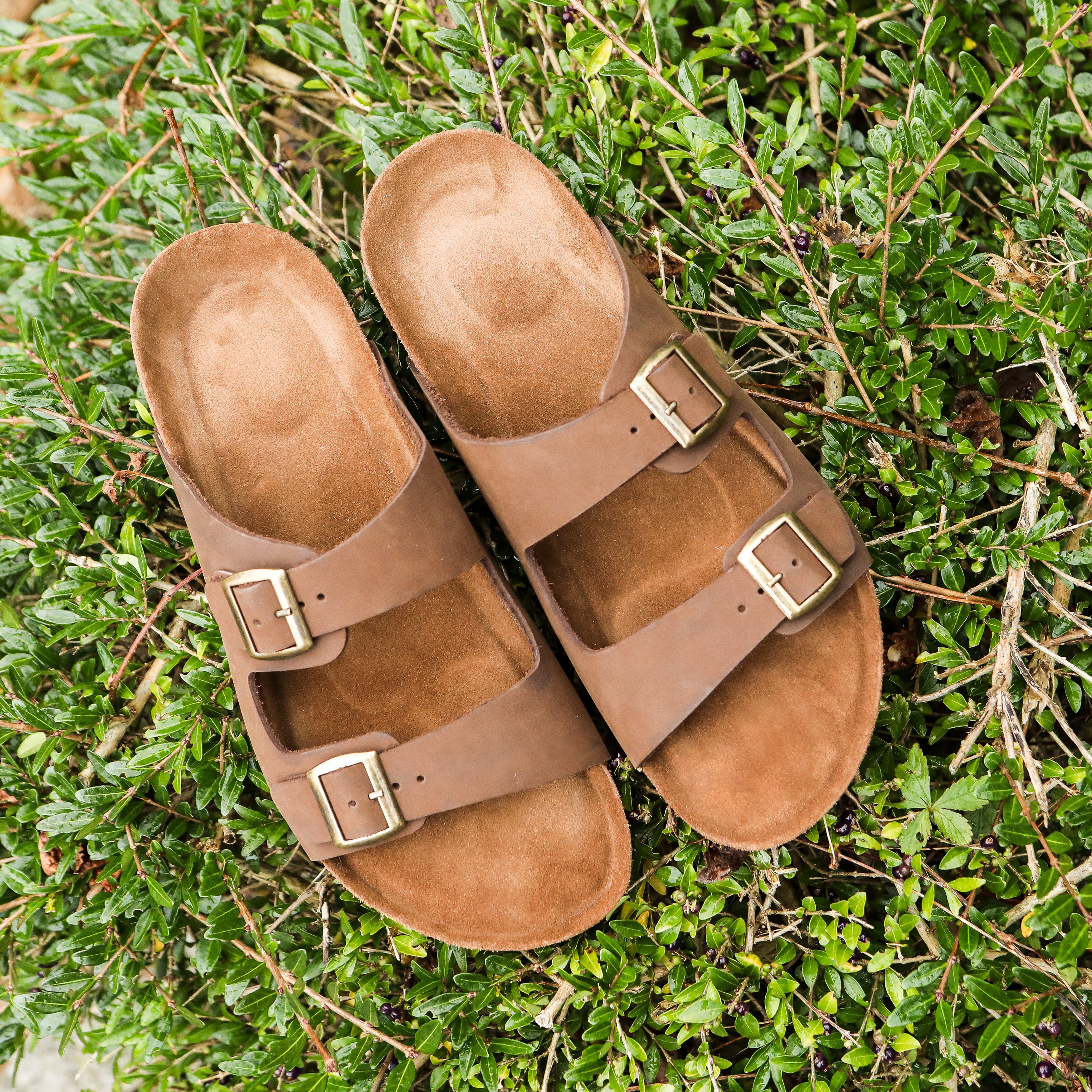
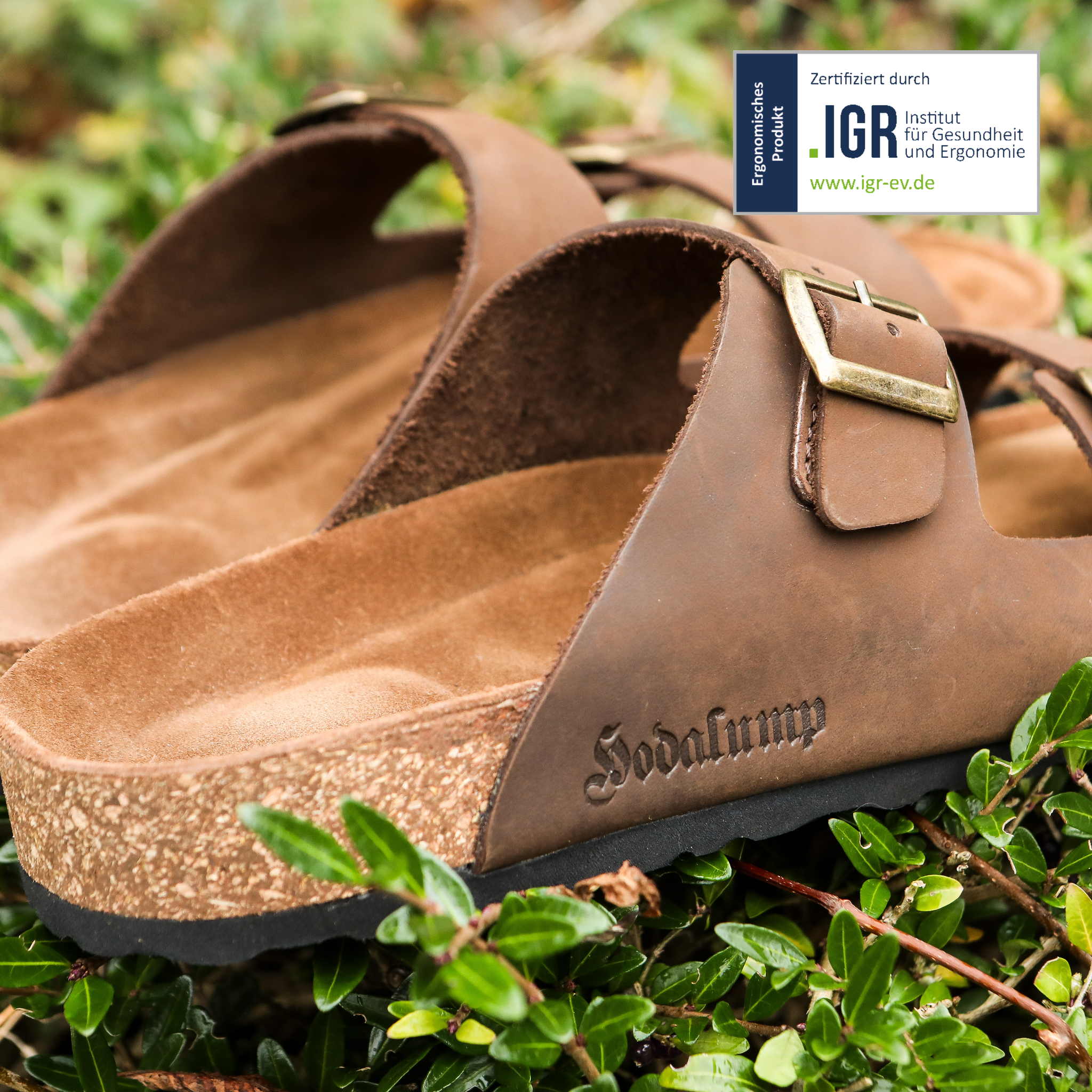
The rest of the footwear range is under Sandals and shoes. Honestly, though: the sandals there are not for lederhosen. They are for the day after.
The belt: with two out of three lederhosen you don't need one
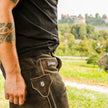
This is one thing people easily buy twice. The Hodalump Lederhose and the Lederhose 2.0 are both supplied with a belt according to the product details. So you don't need a second one unless you deliberately want a different one.
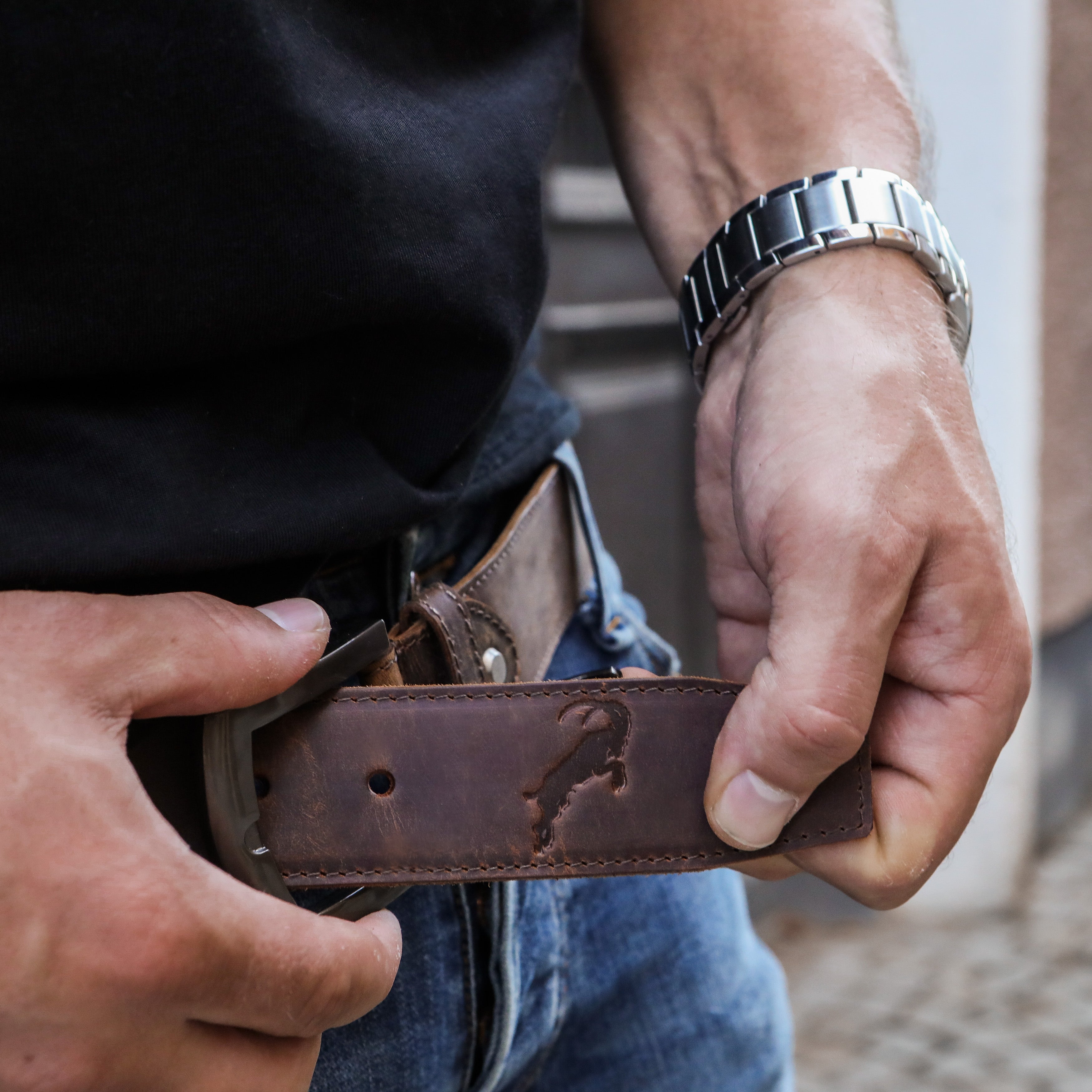
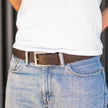
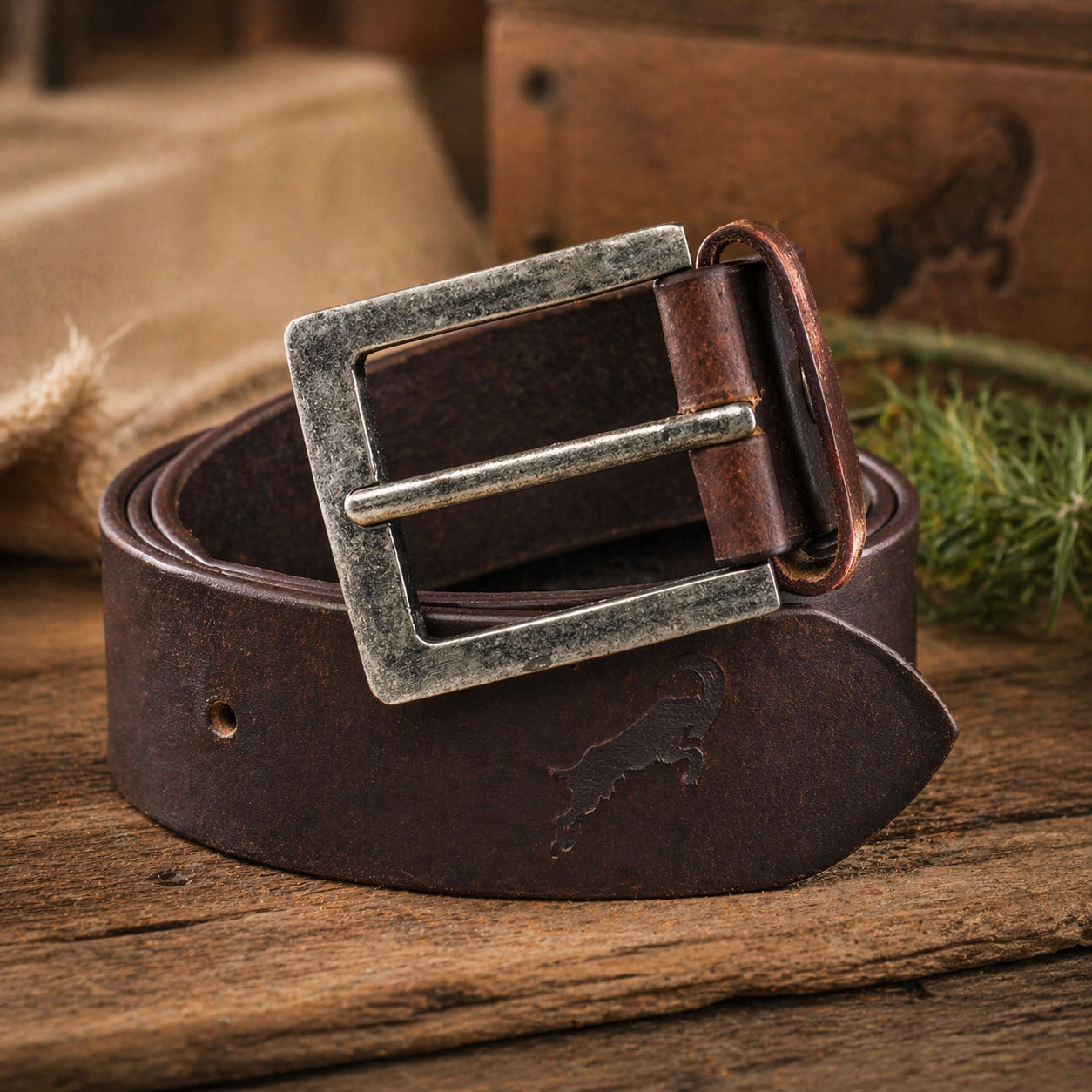
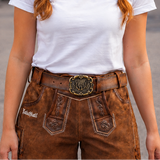
If you do want to swap, the models are listed under leather belts. The brown belt costs €29.95, is 4 cm wide and comes in four lengths: M for a 85 cm waist, L for 95 cm, XL for 105 cm, XXL for 115 cm. It can be shortened if you fall between two sizes.
On the width: 4 cm is the right choice with lederhosen. A slim 2.5 cm suit belt looks like a shoelace on lederhosen — the leather of the trousers is too heavy for such a thin line.
Four things that sink a good look
- Tucking the shirt in. With a shirt it is a matter of taste; with a T-shirt it is almost always wrong.
- Promotional prints. A company logo, a stag do, a beer brand. The trousers cost three figures; the T-shirt turns them into a costume.
- Everything at once. A hat, a waistcoat, a Charivari (the ornamental silver chain worn across the front), a patterned shirt and embroidery on the trousers add up to fancy dress. One eye-catching item per outfit is enough.
- White sports socks in lace-up shoes. With short lederhosen you wear either Loferl — the calf warmers worn without a foot — or nothing visible at all.
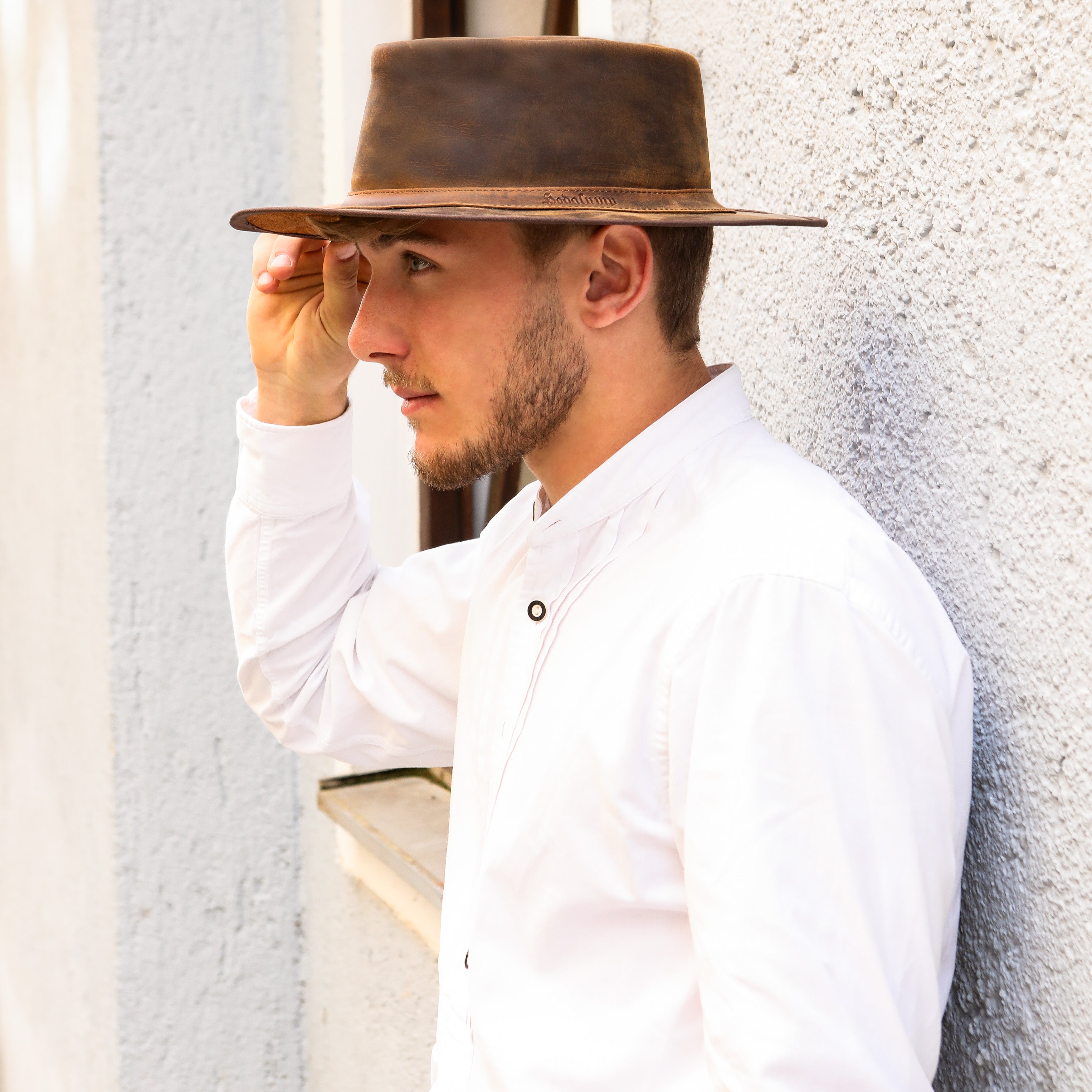
We do not stock Loferl or traditional Bavarian socks — you will have to get those elsewhere. Hats we do stock; they sit with the rest of the Oktoberfest range under Oktoberfest, in Medium 56–57 cm, Large 58–59 cm and XLarge 60–61 cm. If you go for the hat, leave the patterned shirt out.
The three lederhosen in the shop — which one for whom
The shop stocks three pairs of lederhosen, and the differences are quickly told.
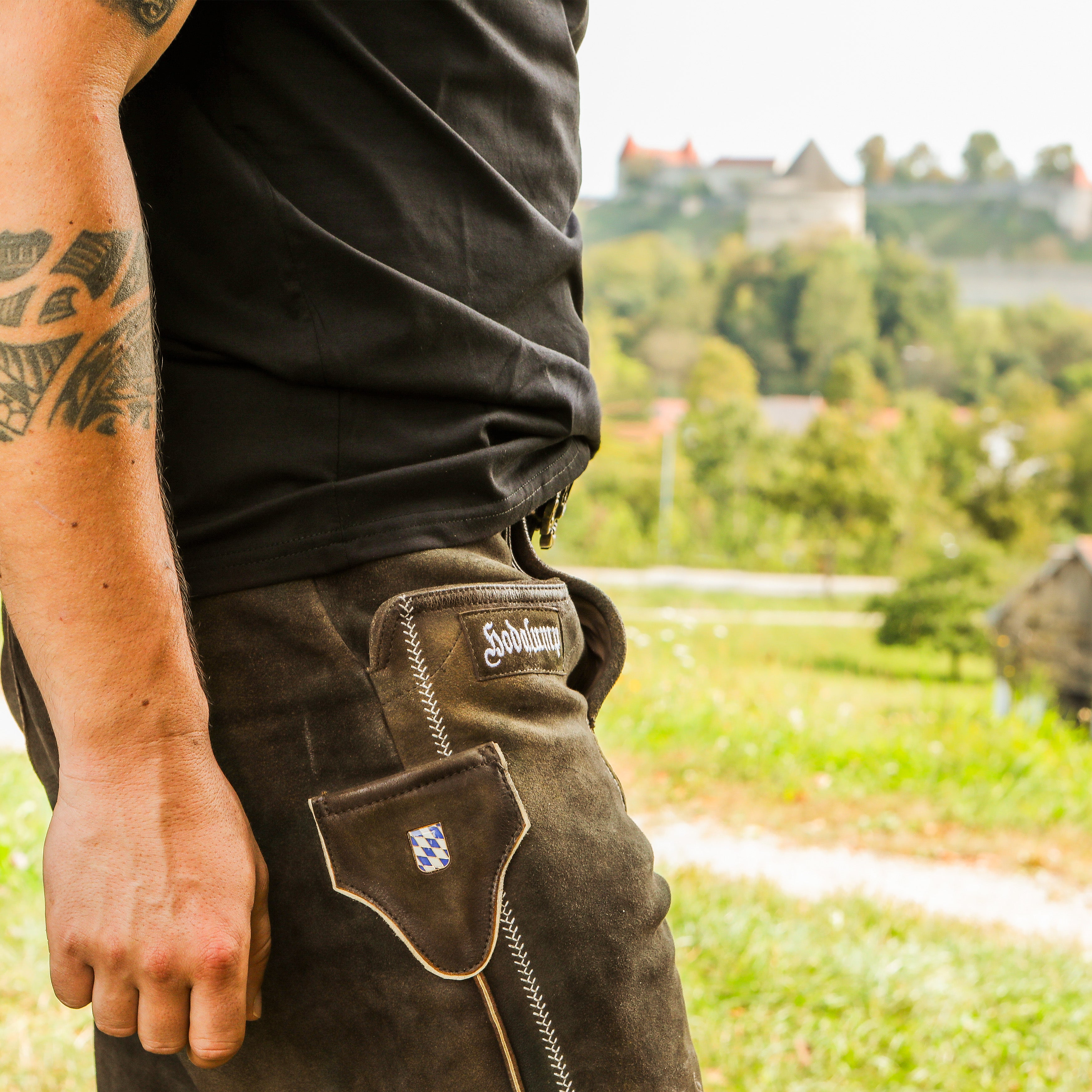
The Hodalump Lederhose at €149.95 is made of goatskin, comes in sizes 48 to 56 and carries a large Bavarian coat of arms. The waist measurements: 82–85 cm in size 48, 86–91 cm in 50, 90–96 cm in 52, 95–102 cm in 54 and 103–110 cm in 56.
The Lederhose 2.0 also costs €149.95 and is the same pair in the same sizes with the same waist measurements — just with an HR logo instead of the coat of arms. That is the whole difference, and we would rather write it down than spin a story out of it.
Important when ordering: German size 48 corresponds to jeans size 31/32, size 50 to a 32/32, size 52 to a 33/32, size 54 to a 34/32 and size 56 to a 36/34. So if you wear a W32, you end up in a 50 and not a 48.
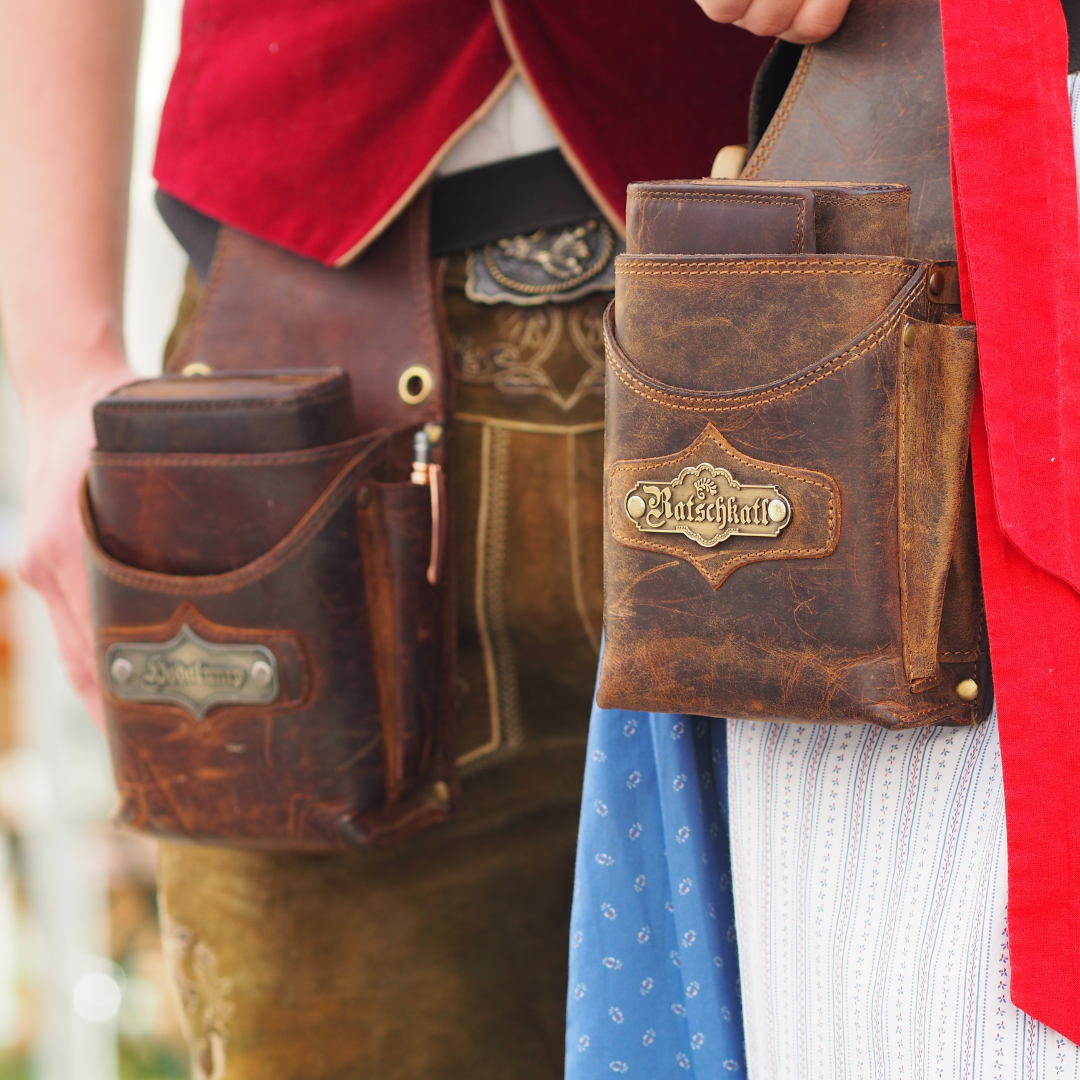
For women there is the Ratschkatl Lederhose at €119.95 in sizes 36 to 44, in soft genuine leather, with stag horn buttons, embroidery and lacing at the leg.
Women: what goes with the Ratschkatl Lederhose
These lederhosen allow three routes, and all three work: a Trachtenbluse — the traditional Bavarian blouse — when the occasion is a formal one. A simple T-shirt for an afternoon in the beer garden. A modern top when the lederhosen are not meant as traditional dress at all, but as what they can equally be — a pair of short leather trousers for an ordinary evening.
With shoes it gets thin, and that should be said: the Haferlschuhe only run from 41 to 46. For most women that is too big. A plain white trainer or a flat boot from your own wardrobe is the more realistic solution here.
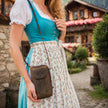
With bags the same rule applies as with the T-shirt: one eye-catching item is enough. Embroidered lederhosen go better with a quiet little shoulder bag than with a patterned one. The Oktoberfest range for women sits in that same Oktoberfest collection.
After the festival: what happens to the trousers
Lederhosen get better over the years, but only if you don't treat them badly. Beer on leather gets dabbed off, not rubbed, and the trousers dry in the air — not on a radiator and not in a tumble dryer. Marks are part of a pair of lederhosen; they are the reason a ten-year-old pair looks better than a new one.
How to care for the leather without leaving it tacky is covered in the article Applying leather grease. In short: sparingly, warm, and better twice thinly than once thickly.