















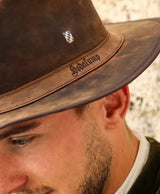



A leather hat is one of the few items of clothing where the size genuinely decides everything. Two centimetres too small and it presses above your ears after an hour; two centimetres too big and it slides down the back of your neck at the first gust of wind. That is why this article starts with a tape measure rather than with looks.
After that it covers the questions people ask in the shop: what does the brim actually do? Will a leather hat take rain? And what is the difference between a leather hat, a cowboy hat and a Capi?
Measure first, then choose
Take a tape measure and lay it horizontally around your head: above the forehead, about a centimetre above the ears, and around the widest curve at the back of the skull. Do not pull it tight — as firm as you want the hat to sit later. The figure in centimetres is your hat size.
| Size | Head circumference |
|---|---|
| Medium | 56–57 cm |
| Large | 58–59 cm |
| XLarge | 60–61 cm |
These three sizes apply to every hat in the leather hats for men. If you fall between two sizes, at 57.5 cm for instance, take the smaller one — leather gives in the width once it warms up and gets worn. The other way round does not work: a hat that is too big never gets smaller.
Two things change the measurement noticeably: thick hair worn high, and how you wear it. If you pull the hat right down onto your forehead, you are measuring lower down the head and may need an extra centimetre.
The three hats — and what sets them apart
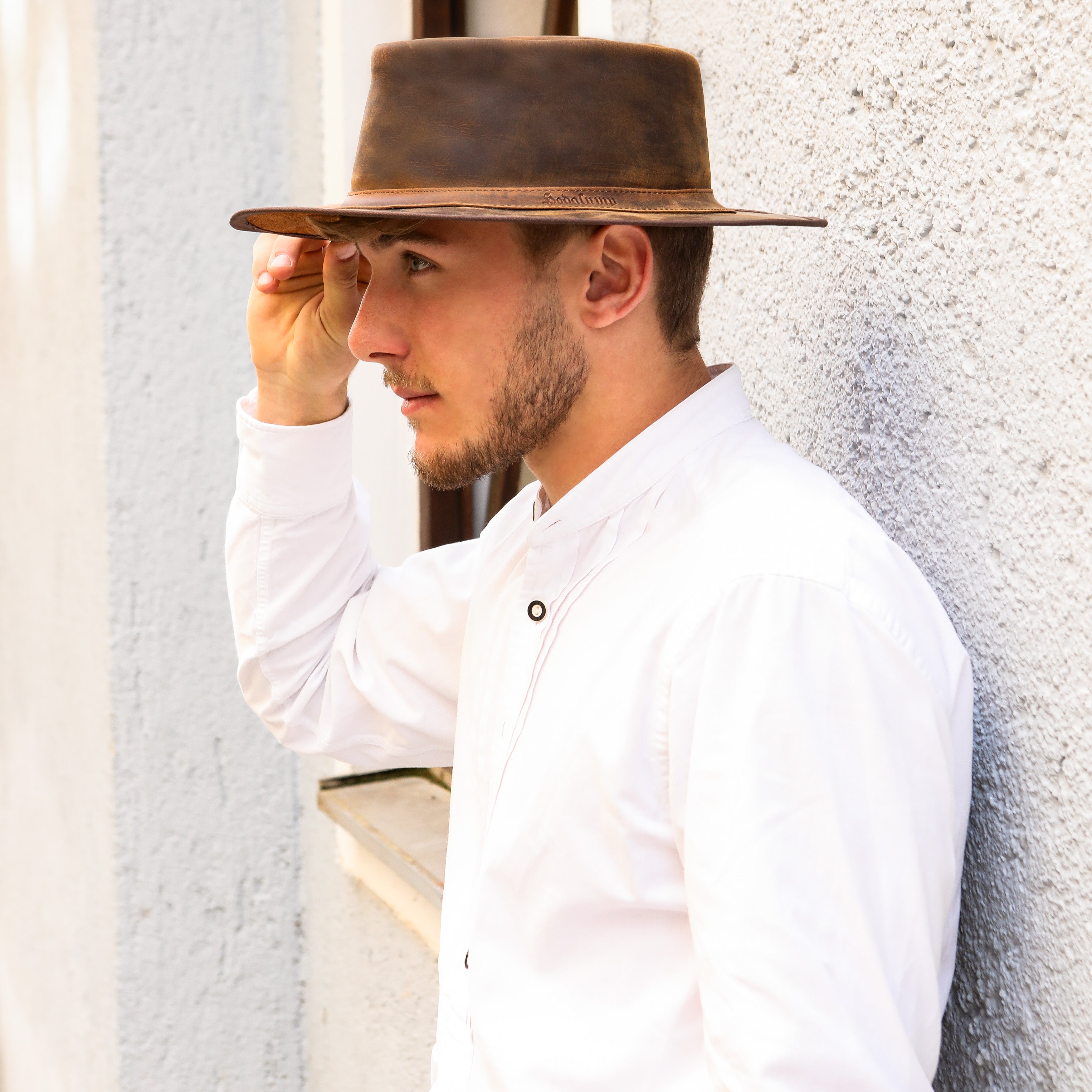
Hodalump Bavaria Hat, €59.95. The most expensive of the three and the one with the clearest link to traditional Bavarian dress. The description calls it Western style with traditional charm — it works with lederhosen just as well as with jeans.
Hodalump Billi Hat, €49.95. The cowboy version, closest in form to the classic Western hat. If you deliberately want that look, this is the one.
Hodalump Lumpi Hat, €49.95. The only one of the three for which the description expressly states buffalo leather. Plus a plain decorative cord and an inner band for grip. In form it is closest to the classic traditional Bavarian hat, only cut more modern.
And because it belongs here too: for the Bavaria Hat and the Billi Hat, the product description only says “robust material”, without naming the type of leather. We would rather write that down than invent a material specification. If the type of leather matters to you, the Lumpi Hat is the only one with a documented answer.
What the brim does
The brim is not a styling detail, it has three jobs — and some of them pull against each other.
- Shade. The wider the brim, the more of your face is in shadow. That is why leather hats are in higher demand in summer than in autumn.
- Water run-off. A brim that curves downwards leads rain away from your face and collar. A brim that sticks out flat collects water across its surface and eventually lets it run off at one point — usually straight down the back of your neck.
- Wind. And here it tips the other way: the wider the brim, the more surface for the wind to catch. Beyond a certain width a hat needs either a cord or a very precise fit.
A brim turned up at the sides, as is typical on a Western hat, is a compromise between the two: protection front and back, less surface for the wind at the sides. That is not fashion, that is physics that grew out of use.
Weatherproof does not mean waterproof
The hat descriptions state that the material is weather-resistant and stands up to wind and rain. That is not a marketing line — leather is naturally water-repellent because the grain layer is dense. But waterproof is something else, and we are not claiming that here.
What a leather hat can actually handle: a shower, a drizzle, half a day of hiking weather. What it cannot: hours of heavy rain. Water finds its way in along the seams and at the point where the brim meets the crown. After an hour in a downpour it is damp inside — that goes for every leather hat and is not a material fault.
If it has got wet, the next hour decides what shape it keeps:
- Dry it at room temperature. Not on a radiator, not in a car in the sun, not with a hairdryer. Drying too fast makes leather hard and shrinks it.
- Stand it on its brim or lay it on a towel so it keeps its shape. Do not lay it on the crown, or the brim will curl up.
- Only once it is completely dry, apply a thin coat of leather grease (€8.95) — thinner than feels right. Grease darkens leather. How much and how often is covered in the guide Applying leather grease.
Capi, cowboy hat, leather hat: what is what
These three get muddled up constantly, when in fact they are three different things.
The leather hat in the narrower sense is a hat with a brim all the way round and a shaped crown made of leather — the traditional Bavarian hat, the Western hat and the forms in between all fall under it.
The cowboy hat is one construction within that: a high crown, a brim turned up at the sides, usually with a lengthwise crease. The Billi Hat goes in that direction.
The Capi is something else entirely. The Hodalump Capi 2.0 (€49.95) is a snapback cap in 100% cotton, adjustable in size, with embroidered motifs. No leather, no brim, no hat. If you search for “Capi” and expect a leather hat, you are looking for the wrong thing — and the same goes the other way round. Both sit in clothing, but they are two different buying decisions.
What you wear it with
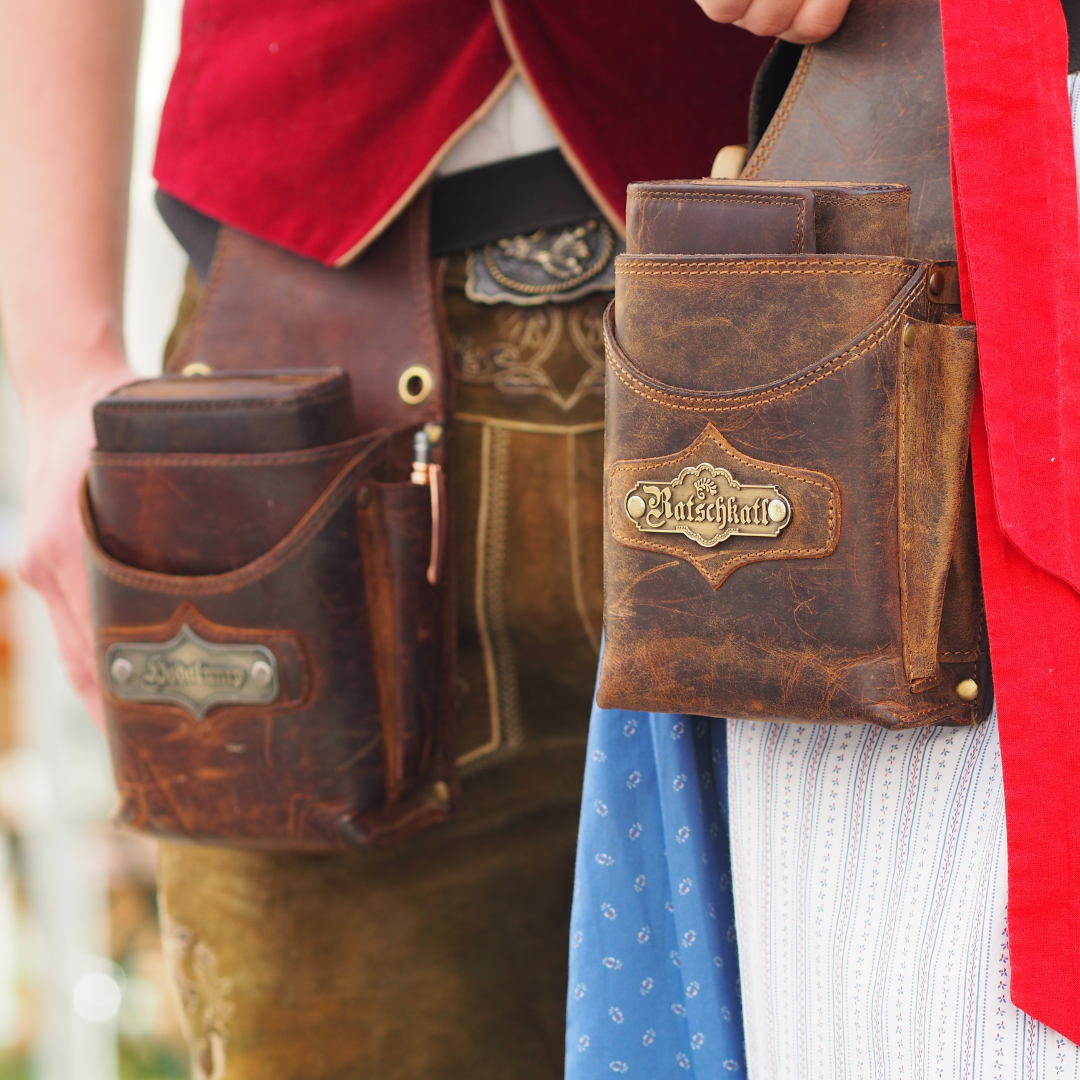
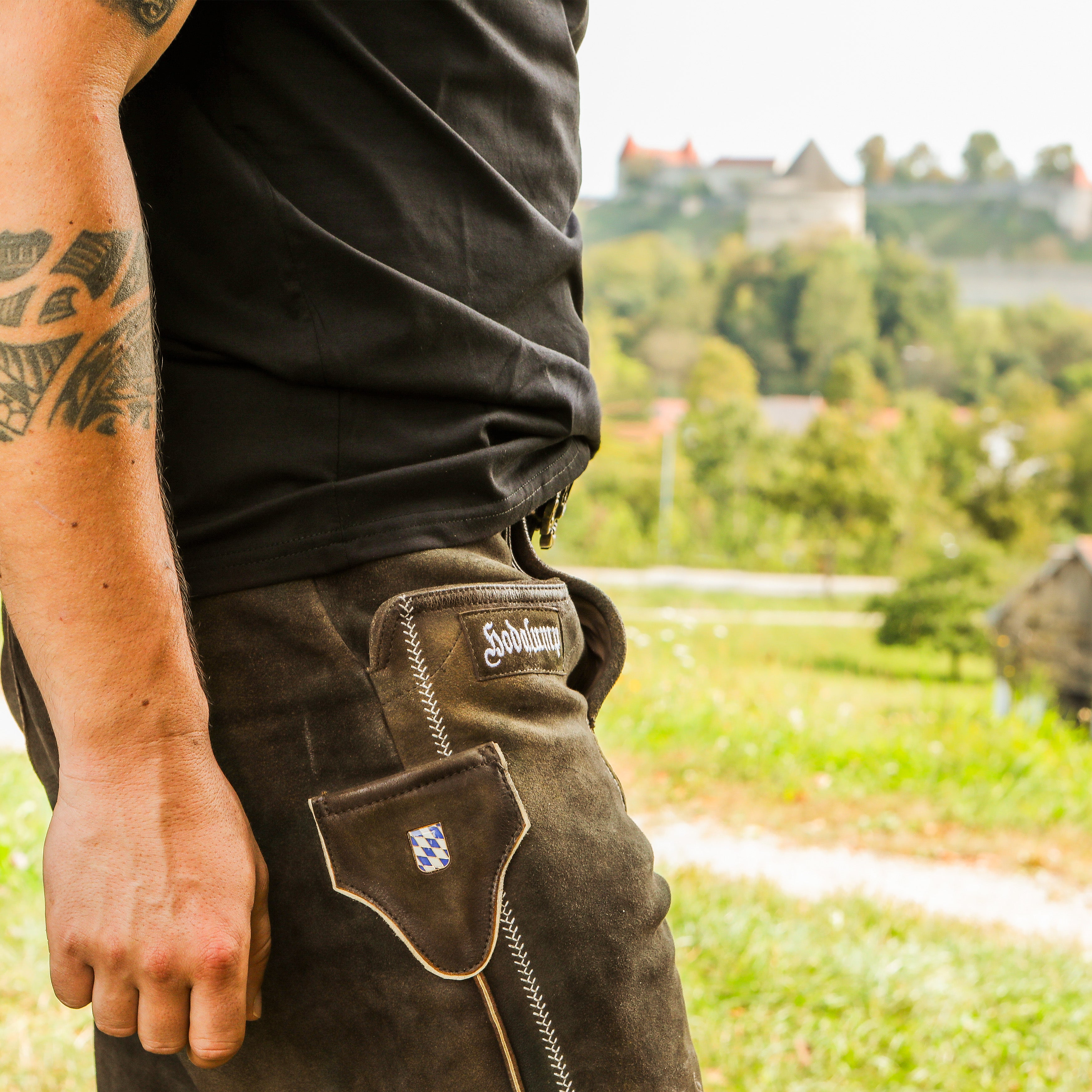
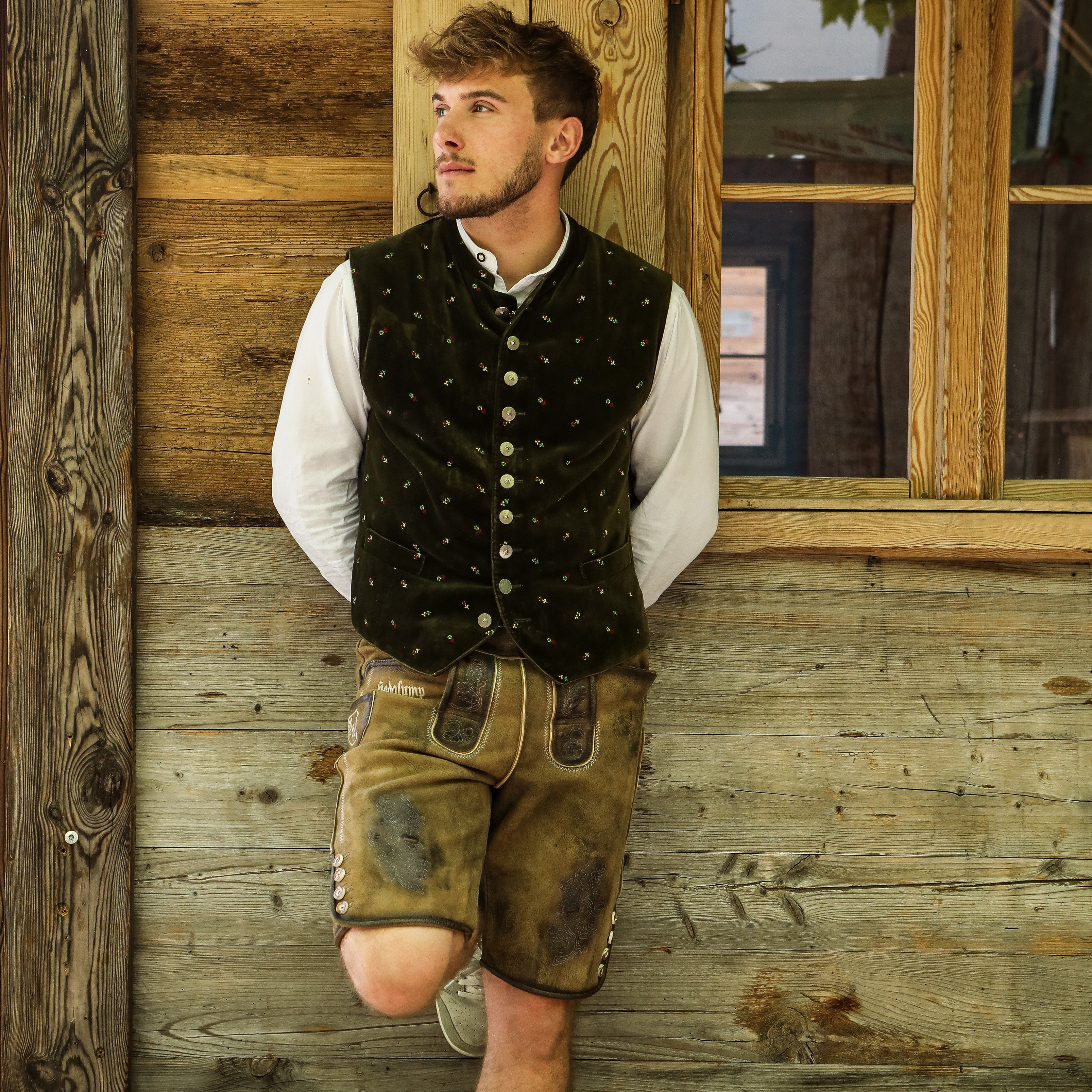
With traditional Bavarian dress the case is clear: hat, shirt, lederhosen, Haferlschuhe — the traditional Bavarian shoe with side lacing. Which lederhosen go with it and what to look out for when buying is covered in the guide Buying lederhosen. For the Wiesn, as the Oktoberfest is known locally, you will find everything that goes around it under Oktoberfest.
Everyday wear is the more interesting case. A leather hat with jeans works if everything else stays calm: a plain shirt or T-shirt, no second attention-grabbing item in the outfit. What does not work is a leather hat plus a leather jacket plus leather boots — at that point you are wearing a costume, not a hat.
And a final practical point: a hat that fits properly holds its shape for years, as long as you do not lay it down on the crown and do not pick it up by the crown. Take it off by the brim, put it down on the brim. That sounds like a trifle, and it is the difference between a hat after five years and a caved-in hat after two.
How to tell it fits
A leather hat fits when it stays put by itself but has stopped making itself felt after ten minutes. Three checks are enough:
- Bend your head forward. It may work loose, but it should not fall off. If it drops straight away, it is a size too big.
- Keep it on for ten minutes, then take it off. If a red mark is left on your forehead, it is too tight. A faint line is normal, a pressure ring is not.
- Look straight into the mirror. The edge of the hat should sit at around mid-forehead height. If it sits on your eyebrows, either you have the wrong size or you are wearing it too low.
If it only presses in one place, usually above the ears, that is down to the shape of your head, not the size. Leather gives a little at that point as you wear it, and the warmth of your head helps. If it is too tight all the way round, on the other hand, nothing will help — that is simply the wrong size.
Why the hat season falls in summer
Most people associate traditional hats with September and October. In fact demand for leather hats is at its highest from May to July, and the reason is fairly simple: a hat with a brim is useful in summer, not decorative. It keeps the sun off your face, it is lighter than any cap with a dense lining, and it is the only headwear that also works with a shirt.
So if you buy one only for the Wiesn, you are buying it for the smaller part of the year. That is not an argument against buying one, but it is an argument for choosing a shape that works without traditional dress too.