




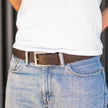
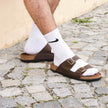



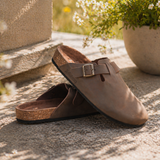
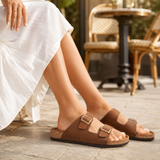
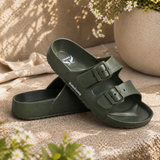
„Schlappen" is not a technical term but a word that means something different depending on the region. In the south of Germany it usually refers to open shoes with a cork sole and a leather strap, worn at home, in the garden and on the terrace. Elsewhere every worn-out slipper goes by the same name. That is why people genuinely search for „what are Schlappen" — and get shown very different shoes.
This article is about the first kind. About shoes you put on in the morning and only take off again in the evening. And about the question that most often goes wrong with open shoes: the size.
What a Schlappen is — and what it can't do
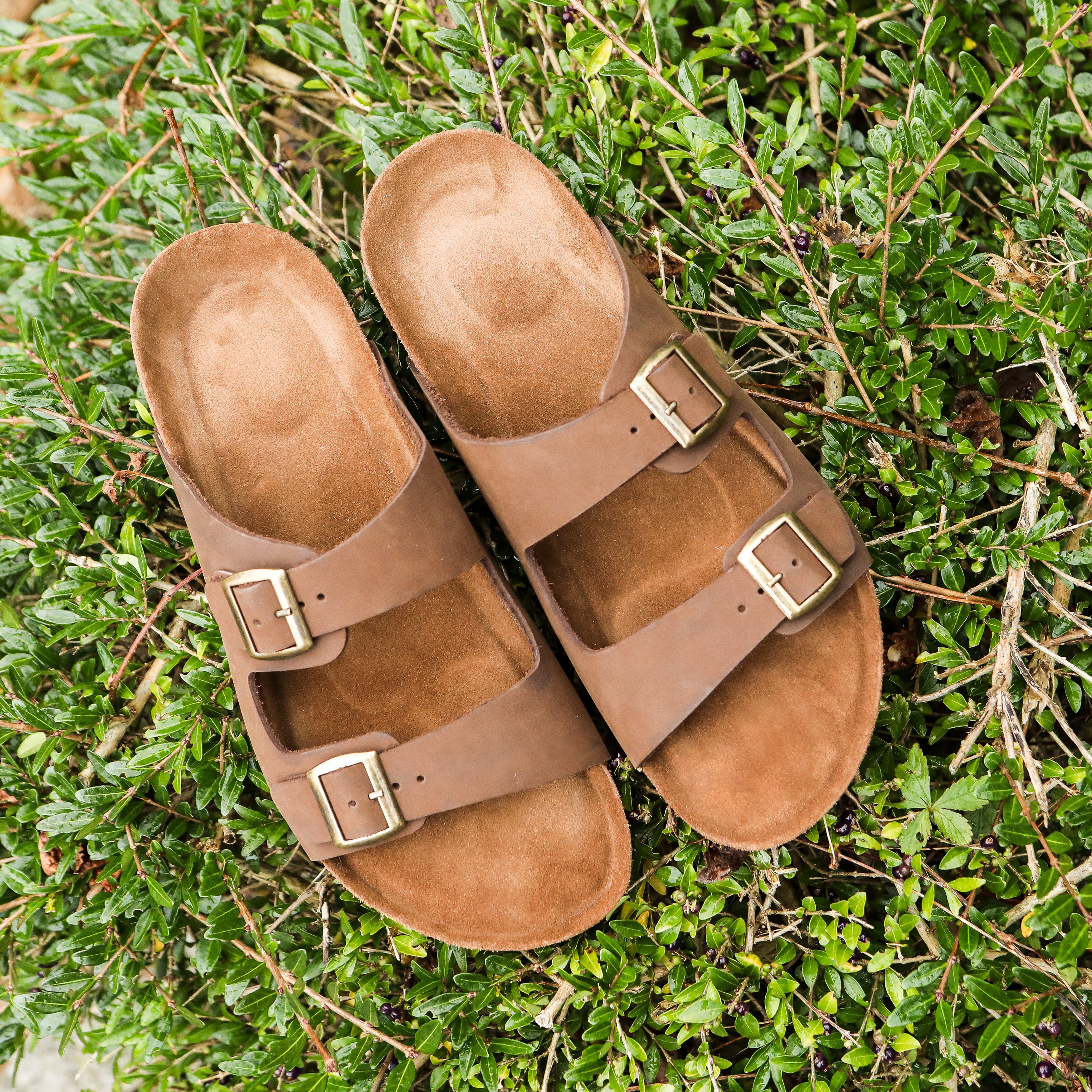
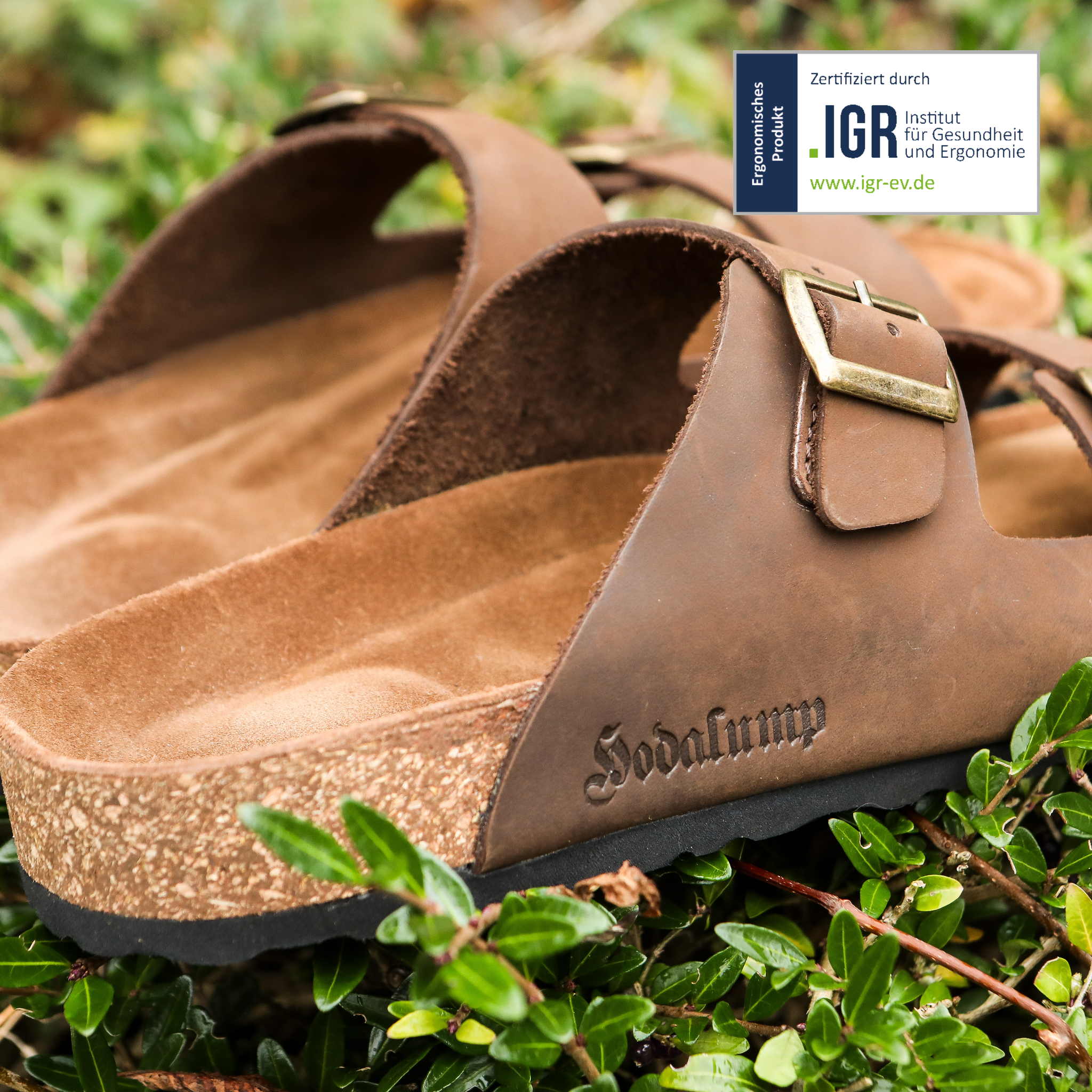
A Schlappen in the sense used on this page is an open shoe: a cork sole, one or two leather straps across the instep, open at the back. No fastening, no heel counter, no hold when you change direction quickly. That is not a weakness, it is the construction. It is what makes the shoe light, airy, and on and off in two seconds.
But it also follows from that what the shoe is not good for. Running, ladders, wet ground at speed, garden work with heavy tools — an open shoe is the wrong choice for those. If you need a closed shoe with support and protection, keep looking in the clothing collection, not here.
One more thing belongs to the construction: a Schlappen is usually worn barefoot. That means the leather strap lies directly on the skin and the cork sole absorbs foot moisture. Both are entirely fine as long as the shoe can dry out in between. Two pairs worn in rotation therefore last longer than one pair worn twice as much.
Cork sole and leather strap: the two parts that matter
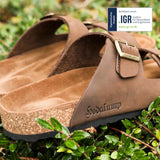
The cork sole is the reason these shoes are more comfortable after two weeks than on the first day. Cork gives under warmth and weight and then holds its shape. After a while the sole has a hollow that belongs to your foot and to no other. That is why borrowed Schlappen feel unpleasant and your own do not.
The leather strap is the second part. It should hold the foot without pressing on the instep. New leather sits tighter at first and softens — that is normal, and it is why you shouldn't judge after the first day. All the cork models in the sandals and shoes range are built this way: cork sole, leather strap, branded logo.
What „non-slip" means here deserves an honest classification. The soles are designed for wooden floors, tiles and carpet — that is, for indoors. On wet ground outside it is a different question, and a cork sole is not made for that.
Size: measure your foot instead of guessing your shoe size
With open shoes every millimetre shows. If the sole is too short, your heel hangs over the edge. If it is too long, the shoe clatters as you walk and you unconsciously grip with your toes — which you notice in the evening. And because the models are cut differently, the same number is not the same length everywhere.
That can be shown. The following sole lengths are taken from the product data (approximate figures; slight deviations are possible):
| Size | Schlappen | Hodalump sandals | Winter Schlappen | PVC sandals |
|---|---|---|---|---|
| 41 | 28 cm | 28 cm | 28 cm | 27.5 cm |
| 42 | 29 cm | 28.5 cm | 28.5 cm | 28 cm |
| 43 | 29.5 cm | 29 cm | 29 cm | 28.5 cm |
| 44 | 30.5 cm | 29.5 cm | 30 cm | 29.5 cm |
| 45 | 31 cm | 30 cm | 31 cm | 30.5 cm |
| 46 | 32 cm | 31 cm | 32 cm | 31.5 cm |
In size 44 there is a full centimetre between the shortest and the longest model. That is the difference between „fits" and „going back". In practice: stand with your foot on a sheet of paper, mark the front and the back, measure the distance and add half a centimetre to a centimetre of room. Compare that figure with the sole length of the model you want — not with the number in your trainers.
The same applies to the women's models on a smaller scale. The plush sandals run from size 36 with a 24 cm sole length to 40 with 27 cm; the Ratschkatl sandals in green from 36 with 25 cm to 40 with 27.5 cm. Same number, up to a centimetre of difference. If you fall between two sizes, go for the larger one with cork: the hollow only forms over time anyway, and a sole that is too short will never get longer.
Long shifts on your feet — where a Schlappen helps and where it doesn't
Anyone working front of house stands for eight to twelve hours and covers more ground in that time than most office workers do in a week. The obvious thought is to put on something airy for those hours. That is the wrong thought.
An open shoe with a free heel does not belong in a kitchen and not behind a bar. Cutlery gets dropped there, hot liquid gets tipped out, the floor is wet. If your employer requires closed shoes, that is not a question of comfort — in that case the Hodalump Boots at €84.95 are the topic: S1-certified, with a steel toe cap, an extra strong non-slip sole and a water-repellent upper.
The Schlappen is the shoe for afterwards. After the late shift, when you get home at half past twelve and your feet are hot. That is not a small benefit, but it is that one and no other. What else belongs to a shift — wallet, holster, small kit — is set out in the article Putting together a waiter's set.
Summer, winter, terrace: which model for which use
The models differ less in construction than in what they are for.
- The Schlappen at €59.95 are the standard model with a cork sole and leather strap, sizes 41 to 47. Rated 4.78 from 67 responses.
- The Ratschkatl cork sandals at €54.95 are the version with the Ratschkatl logo, same construction.
- The Hodalump sandals at €54.95 come up slightly shorter — see the table above.
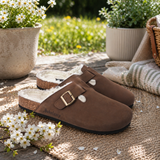
- The Winter Schlappen at €44.95 additionally have a lining of 100% polyester. That is the difference between November and July.
- The PVC sandals at €23.95 are not leather Schlappen but the opposite: waterproof, easy to look after, non-slip sole, for the lake, the garden and the barbecue.
The split is simple: cork and leather for indoors and for dry outdoor use, PVC for anything that might get wet. If you need both, buy both — at €23.95 for the second pair that is not a difficult sum. The table above sets the five models side by side; the recommendation comes first.
What you should not do with a Schlappen
The most important rule is stated in the product notes and still gets ignored regularly: keep cork and leather out of water. Not in the washing machine, not under the garden hose, not straight out of the pool with wet feet. Cork soaks itself full and loses its shape, the leather strap goes hard and stays that way. A pair of cork sandals gets soaked through exactly once and is a different shoe afterwards.
Keep them dry, brush them off occasionally, and treat the leather strap now and then with leather grease at €8.95 — how to do that, and how little of it is enough, is set out in Applying leather grease properly. And if you really are expecting wet feet, take the PVC version from the outset. That is what it is there for.
What the whole thing costs
The range runs from €23.95 for the PVC sandals to €84.95 for the closed models. The cork Schlappen sit in between, at €44.95 to €59.95. That is more than a supermarket slipper and less than a street shoe — and it is the bracket in which a cork sole is still made of cork and a leather strap of leather.
If you are unsure: measure the foot, take the model with the matching sole length, and give it two weeks. By then the cork will have decided where your foot belongs. What else in leather belongs in everyday use is under leather accessories.